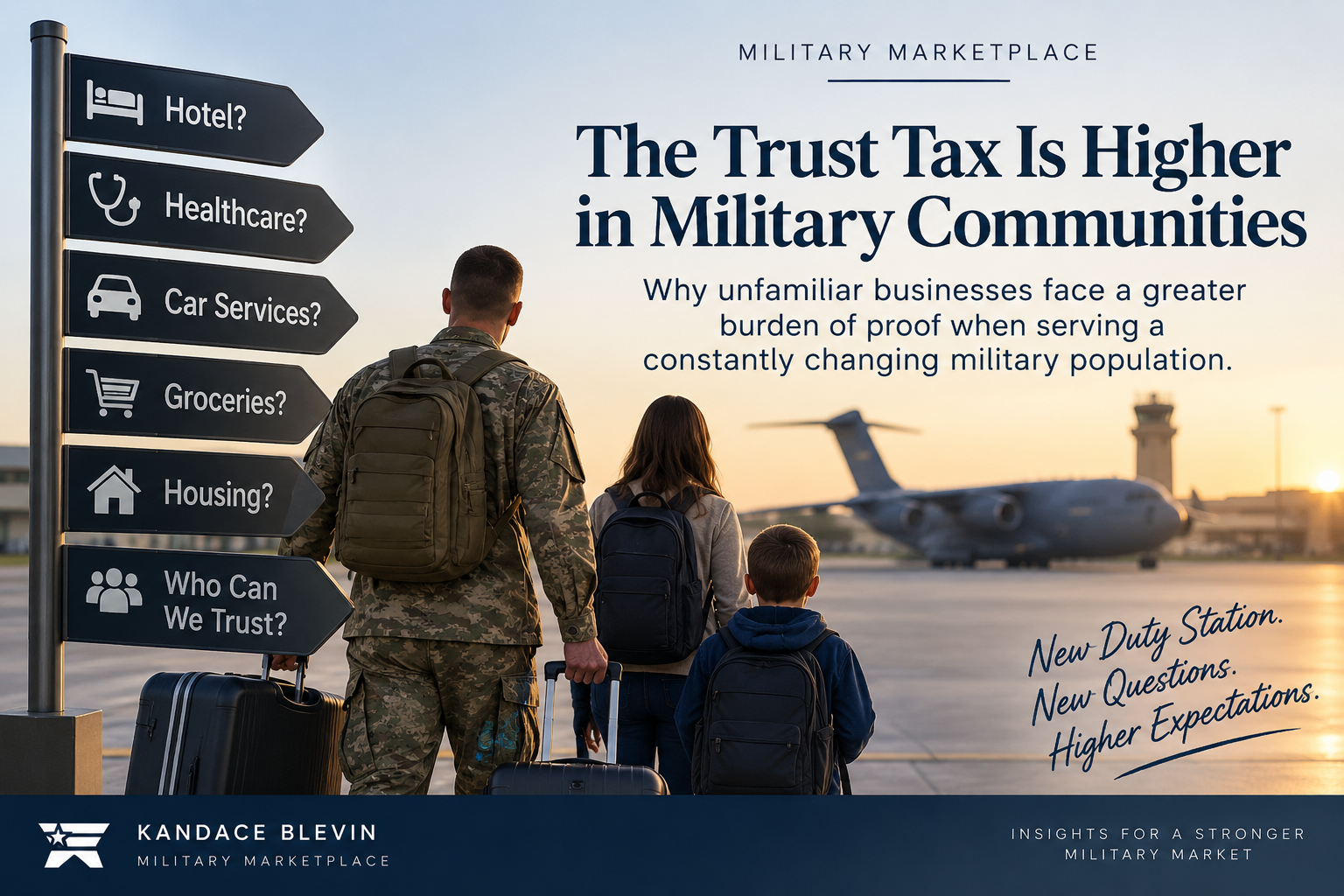
Why unfamiliar businesses face a greater burden of proof when serving a constantly changing military population
Every business has to earn trust.
When a customer encounters a company for the first time, there is inevitably some uncertainty. The customer does not yet know whether the business will deliver what it promises, whether the service will meet expectations or how the company will respond if something goes wrong. Established businesses have an advantage because years of visibility, reviews, recommendations and successful customer interactions have already answered some of those questions.
I call the uncertainty an unfamiliar business has to overcome the trust tax.
I first explored this idea in my Advisor’s Edge article, The Trust Tax: What New Businesses Pay That Established Brands Don’t. The premise was relatively simple: every unfamiliar business carries a higher burden of proof because customers have less evidence available to help them make a confident decision. As familiarity and credible evidence accumulate, that burden gradually decreases.
In military communities, however, there is another dimension to the problem.
Businesses are often introducing themselves to customers who are also being introduced to the market.
A family arriving at Ramstein does not necessarily know which German businesses Americans routinely use. A servicemember arriving at Aviano may have no established relationship with local banks, hotels, restaurants or automotive services. Someone assigned to SHAPE may be navigating Belgium, military bureaucracy and a new local marketplace simultaneously.
Even businesses that have operated near an installation for twenty years can therefore encounter customers who experience them as though they opened yesterday.
That is why the trust tax can be considerably higher in military communities.
Every PCS Cycle Resets Part of the Marketplace
Most local businesses benefit from accumulated community knowledge.
Residents learn which restaurant has been there for years, which mechanic their neighbors trust and which dentist seems to have treated everyone in town. That knowledge moves through families, workplaces and social networks. Over time, established businesses become part of the local landscape.
Military communities operate differently because a significant portion of the population is continually rotating.
People arrive. People leave. New assignments begin. PCS orders move families across states, countries and continents. With every cycle, some of the accumulated familiarity that businesses worked to establish walks out of the market and a new group of consumers arrives without it.
That creates an unusual marketing challenge.
A restaurant outside an installation may be extremely well known among people who have been stationed there for several years, while remaining completely unknown to a family that arrived three days ago. A veterinarian may have hundreds of satisfied American customers and still need to establish credibility with every new wave of pet owners. A university may have served military students for decades while each newly assigned servicemember encounters the institution for the first time.
The business may be established, but the relationship is new.
This is one reason sustained visibility matters so much in military markets. Businesses are continually rebuilding familiarity with a changing audience.
Overseas Military Communities Add Another Layer of Uncertainty
The trust tax becomes particularly interesting overseas because the consumer is often evaluating more than the business.
They may also be evaluating the country, language, customs and unfamiliar commercial practices surrounding it.
Consider an American family arriving in Germany and looking for a veterinarian.
They may wonder whether the staff speaks English, whether the clinic understands the documentation required for military families traveling with pets, whether American credit cards are accepted, how appointments work and whether the experience will resemble what they are accustomed to in the United States.
The veterinarian may be excellent. It may have operated successfully for thirty years and have an outstanding reputation among German customers.
Yet the newly arrived American still has unanswered questions.
The same dynamic can affect hotels, healthcare providers, financial institutions, insurance companies, restaurants, automotive businesses, tourism providers and many other categories serving military communities overseas.
The customer is evaluating whether the business is trustworthy while simultaneously trying to determine whether it understands people like them.
That additional uncertainty raises the burden of proof.
Businesses that recognize this can reduce friction by making military relevance easier to establish. English-language information helps. Clear explanations help. Reviews from other military customers can help. A history of serving the community helps, particularly when that history can actually be discovered.
This connects directly to the question I explored in my previous Military Marketplace article, What Does the Internet Tell the Military Community About Your Business?
A reputation that exists primarily through local knowledge becomes less useful when the next customer has just arrived.
Military Consumers Borrow Trust
When people lack firsthand knowledge, they often borrow confidence from people and institutions they already trust.
This happens everywhere, but military communities create particularly strong examples.
A newcomer asks coworkers where they take their car. A spouse asks a community group for veterinarian recommendations. Someone sees the same hotel repeatedly mentioned by other Americans. A family receives a relocation publication during the arrival process and begins using it to understand the surrounding community.
The recommendation does not have to close the sale. It simply reduces uncertainty enough for the consumer to investigate further.
Trusted environments can work similarly.
A business encountered through an established military-community resource begins with context that an unknown company appearing randomly online may lack. The consumer still evaluates the business, reads reviews, checks the website and makes an independent decision, but the initial encounter happens within an environment already associated with the community they are trying to understand.
This is one of the reasons I believe military-market advertising should be evaluated through more than immediate clicks and conversions.
Context matters.
Where someone encounters a business can influence how that business is perceived.
Familiarity Becomes Particularly Valuable When Time Is Short
PCS also compresses decision-making.
A newcomer may need certain services immediately. Hotels, transportation, mobile service, banking, insurance, restaurants and essential household purchases can become priorities within days of arrival. Healthcare, education, childcare, travel and other decisions follow as the family becomes established.
Consumers do not necessarily have months to develop familiarity with every company they might use.
Businesses therefore benefit when familiarity begins before the moment of need.
Someone may see a company in a Welcome Guide during arrival. Later, they notice the same business on a military-community website. They encounter an advertisement, see a promotional item, hear the name from a coworker or notice positive reviews while searching online.
None of those encounters necessarily produces an immediate sale.
Together, however, they can change what happens when the need finally appears.
Instead of evaluating a completely unknown company, the consumer recognizes the name.
Recognition does not guarantee trust, but it reduces some of the uncertainty that makes an unfamiliar purchase feel risky. That was central to the original Trust Tax framework: repeated exposure and credible associations gradually turn an unknown organization into a familiar one.
In military communities, the value of that process is amplified because the audience itself keeps renewing.
Credibility Has to Be Visible
There is another complication.
A business can be highly credible without making that credibility easy for newcomers to see.
Imagine a company that has served the Kaiserslautern Military Community since the 1990s. Perhaps thousands of Americans have used it. Local residents know the company. Long-term customers recommend it.
Yet its website barely mentions military customers. Its Google profile contains incomplete information. Reviews provide little context. There are few independent references connecting the company to the military community.
The credibility exists.
A newcomer simply has difficulty seeing it.
This is where the previous articles in this series begin connecting.
In How the Military Community Discovers Businesses Today, I looked at the growing number of places where discovery occurs.
In What Does the Internet Tell the Military Community About Your Business?, I examined the digital evidence consumers find after that discovery occurs.
The trust tax explains why those things matter.
Discovery creates the opportunity to be considered. Digital evidence helps the consumer evaluate what they have found. Repeated visibility, credible associations and positive experiences gradually reduce the uncertainty surrounding the decision.
This is also where our later discussion of AI will become important.
AI Is Becoming Another Participant in the Trust Process
In the original Advisor’s Edge article, I argued that AI is reinforcing the importance of credibility because AI systems also need information from which to evaluate relevance and context. Businesses that leave behind a broader trail of reviews, articles, mentions and credible associations provide more information that can potentially be interpreted.
For the military marketplace, that creates an interesting convergence.
The newly arrived consumer is asking:
Can I trust this business?
Search engines and AI systems are trying to answer related questions:
What is this business? Where is it? What does it do? Who does it serve? Is it relevant to what this person is asking?
That does not mean AI evaluates trust exactly as a person does, and businesses should be wary of anyone promising that a particular tactic will guarantee AI recommendations.
It does mean that businesses increasingly benefit from leaving behind a clear and credible record of who they are.
The same reviews, accurate information, useful website content, independent references and credible community associations that help a military newcomer evaluate a business also create a richer digital footprint.
Human trust and digital discoverability are beginning to overlap.
That overlap will become increasingly important as consumers move from traditional search toward conversational discovery.
How Businesses Can Lower the Military Trust Tax
For a business trying to reach the U.S. military community, lowering the trust tax begins with recognizing the specific uncertainty your customer may be experiencing.
Ask yourself what a newcomer would need to know before feeling comfortable choosing you.
Then examine whether the evidence is available.
Does your website make your military experience clear? Can customers easily determine where you are located and what communities you serve? Do reviews provide evidence that other Americans have successfully used your business? Are you visible in places military consumers already use for information? Does your business remain present throughout the year, or does it appear briefly during campaigns and then disappear?
Most importantly, consider whether your marketing is creating a pattern.
One advertisement creates an encounter. A recommendation creates another. A useful article adds context. A Welcome Guide appearance sitting in a rack on base or handed to a soldier at intake creates visibility during relocation. Programmatic advertising can maintain awareness across the wider digital environment. A promotional product may keep the company physically present. Positive customer experiences create reviews and word of mouth that continue after the advertising itself is gone.
The original Trust Tax article made the case that credibility is usually built through accumulated evidence rather than a single interaction.
Military communities make that accumulation especially valuable because businesses are continually introducing themselves to the next group of arrivals.
Q&A: Trust and the Military Marketplace
Do military consumers automatically trust businesses that advertise in military media?
No. Consumers still evaluate businesses independently, and no advertising environment can substitute for good service, accurate information and a strong reputation. Appearing within familiar military-community environments can provide useful context and increase familiarity, particularly for newcomers who are still learning the local market.
How long does it take to build familiarity in a military community?
There is no universal timetable. Business category, purchase frequency, competition, location and advertising intensity all matter. The more important principle is continuity. Military populations rotate, so businesses benefit from treating familiarity as an ongoing process rather than a campaign that is completed once awareness has been achieved.
Does this apply only to new businesses?
No. An established local company can effectively be “new” to every incoming military consumer. This is one of the defining differences between traditional local marketing and military-market marketing.
Can reviews alone establish trust?
Reviews are extremely useful, but consumers often evaluate several kinds of information together. A credible website, accurate listings, recommendations, media presence, community visibility and consistent information can reinforce what reviews already suggest.
A Final Thought
The military marketplace creates an unusual paradox for established businesses.
You can spend decades earning a reputation and still meet thousands of customers each year who have never heard your name.
That means familiarity cannot simply be achieved and then maintained passively. Every PCS cycle introduces another audience that needs to discover who you are, understand why you are relevant and gather enough evidence to feel comfortable choosing you.
For businesses serving military communities, the trust tax is therefore something that must continually be reduced.
The companies that do this well remain visible. They make their experience easy to verify. They appear in credible environments. They give customers useful information before asking them to buy. Most importantly, they remain present long enough for individual encounters to become a recognizable pattern.
Because in a community where the customer base continually changes, being established is valuable.
Being recognized as established is even more valuable.
Schedule a Strategy Session
If your business is trying to reach the U.S. military community and you would like to explore how print, digital advertising, programmatic targeting, military-community media or promotional products could work together, please feel free to contact me through my Booking Calendar.
I can help you evaluate the available options and determine which combination makes sense for your audience, location, objectives and budget.
Kandace Blevin, Multimedia Consultant | Stars and Stripes
Military Audience Strategy • Integrated Advertising • Digital Marketing
Blevin.Kandace@Stripes.com | WhatsApp: +49 172-666-8134
Related Articles
From Military Marketplace
- How the Military Community Discovers Businesses Today
- What Does the Internet Tell the Military Community About Your Business?
- Will AI Recommend Your Business to a Military Customer?
- Reaching the U.S. Military Community: A Practical Guide to Stars and Stripes Publications
- When Visibility Becomes Discovery: How Sponsored Content Connects Businesses With Military Communities
- Beyond the Logo: Why Promotional Products Can Support More Than Marketing
From Advisor’s Edge
- Why Visibility Is Changing and Why Small Businesses Can’t Ignore AI
- What AI Actually Looks for When Recommending a Business
- Reputation Is the New SEO: Reviews, Sentiment & Trust
- How Visibility Patterns Influence AI Recommendations
- How AI Reads Your Brand
- Why Most Businesses Aren’t Showing Up in AI Search, And How to Fix It