Tag: Business Strategy

  • The Trust Tax Is Higher in Military Communities

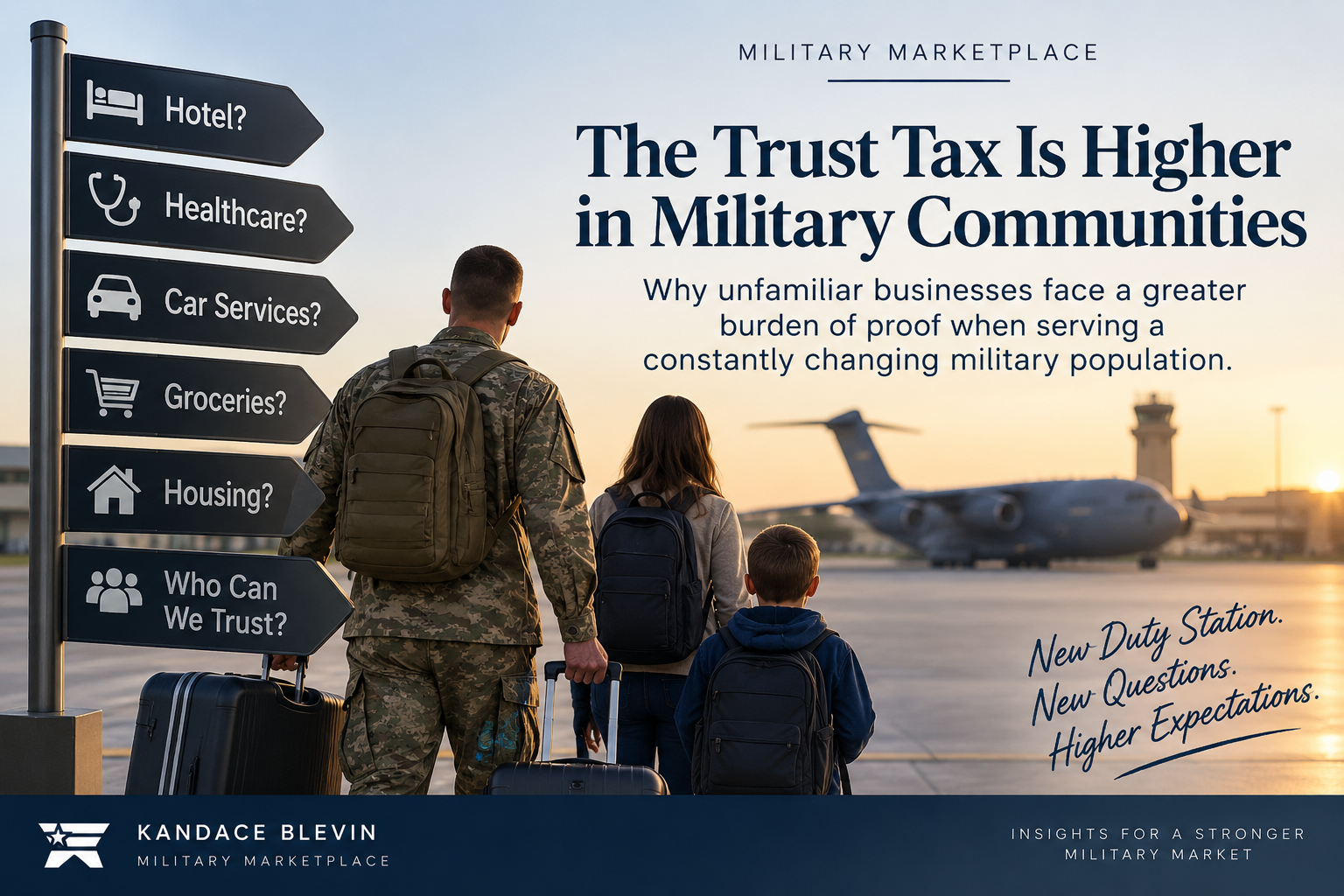
    The Trust Tax Is Higher in Military Communities

    Why unfamiliar businesses face a greater burden of proof when serving a constantly changing military population


    Every business has to earn trust.

    When a customer encounters a company for the first time, there is inevitably some uncertainty. The customer does not yet know whether the business will deliver what it promises, whether the service will meet expectations or how the company will respond if something goes wrong. Established businesses have an advantage because years of visibility, reviews, recommendations and successful customer interactions have already answered some of those questions.

    I call the uncertainty an unfamiliar business has to overcome the trust tax.

    I first explored this idea in my Advisor’s Edge article, The Trust Tax: What New Businesses Pay That Established Brands Don’t. The premise was relatively simple: every unfamiliar business carries a higher burden of proof because customers have less evidence available to help them make a confident decision. As familiarity and credible evidence accumulate, that burden gradually decreases.

    In military communities, however, there is another dimension to the problem.

    Businesses are often introducing themselves to customers who are also being introduced to the market.

    A family arriving at Ramstein does not necessarily know which German businesses Americans routinely use. A servicemember arriving at Aviano may have no established relationship with local banks, hotels, restaurants or automotive services. Someone assigned to SHAPE may be navigating Belgium, military bureaucracy and a new local marketplace simultaneously.

    Even businesses that have operated near an installation for twenty years can therefore encounter customers who experience them as though they opened yesterday.

    That is why the trust tax can be considerably higher in military communities.


    Every PCS Cycle Resets Part of the Marketplace

    Most local businesses benefit from accumulated community knowledge.

    Residents learn which restaurant has been there for years, which mechanic their neighbors trust and which dentist seems to have treated everyone in town. That knowledge moves through families, workplaces and social networks. Over time, established businesses become part of the local landscape.

    Military communities operate differently because a significant portion of the population is continually rotating.

    People arrive. People leave. New assignments begin. PCS orders move families across states, countries and continents. With every cycle, some of the accumulated familiarity that businesses worked to establish walks out of the market and a new group of consumers arrives without it.

    That creates an unusual marketing challenge.

    A restaurant outside an installation may be extremely well known among people who have been stationed there for several years, while remaining completely unknown to a family that arrived three days ago. A veterinarian may have hundreds of satisfied American customers and still need to establish credibility with every new wave of pet owners. A university may have served military students for decades while each newly assigned servicemember encounters the institution for the first time.

    The business may be established, but the relationship is new.

    This is one reason sustained visibility matters so much in military markets. Businesses are continually rebuilding familiarity with a changing audience.


    Overseas Military Communities Add Another Layer of Uncertainty

    The trust tax becomes particularly interesting overseas because the consumer is often evaluating more than the business.

    They may also be evaluating the country, language, customs and unfamiliar commercial practices surrounding it.

    Consider an American family arriving in Germany and looking for a veterinarian.

    They may wonder whether the staff speaks English, whether the clinic understands the documentation required for military families traveling with pets, whether American credit cards are accepted, how appointments work and whether the experience will resemble what they are accustomed to in the United States.

    The veterinarian may be excellent. It may have operated successfully for thirty years and have an outstanding reputation among German customers.

    Yet the newly arrived American still has unanswered questions.

    The same dynamic can affect hotels, healthcare providers, financial institutions, insurance companies, restaurants, automotive businesses, tourism providers and many other categories serving military communities overseas.

    The customer is evaluating whether the business is trustworthy while simultaneously trying to determine whether it understands people like them.

    That additional uncertainty raises the burden of proof.

    Businesses that recognize this can reduce friction by making military relevance easier to establish. English-language information helps. Clear explanations help. Reviews from other military customers can help. A history of serving the community helps, particularly when that history can actually be discovered.

    This connects directly to the question I explored in my previous Military Marketplace article, What Does the Internet Tell the Military Community About Your Business?

    A reputation that exists primarily through local knowledge becomes less useful when the next customer has just arrived.


    Military Consumers Borrow Trust

    When people lack firsthand knowledge, they often borrow confidence from people and institutions they already trust.

    This happens everywhere, but military communities create particularly strong examples.

    A newcomer asks coworkers where they take their car. A spouse asks a community group for veterinarian recommendations. Someone sees the same hotel repeatedly mentioned by other Americans. A family receives a relocation publication during the arrival process and begins using it to understand the surrounding community.

    The recommendation does not have to close the sale. It simply reduces uncertainty enough for the consumer to investigate further.

    Trusted environments can work similarly.

    A business encountered through an established military-community resource begins with context that an unknown company appearing randomly online may lack. The consumer still evaluates the business, reads reviews, checks the website and makes an independent decision, but the initial encounter happens within an environment already associated with the community they are trying to understand.

    This is one of the reasons I believe military-market advertising should be evaluated through more than immediate clicks and conversions.

    Context matters.

    Where someone encounters a business can influence how that business is perceived.


    Familiarity Becomes Particularly Valuable When Time Is Short

    PCS also compresses decision-making.

    A newcomer may need certain services immediately. Hotels, transportation, mobile service, banking, insurance, restaurants and essential household purchases can become priorities within days of arrival. Healthcare, education, childcare, travel and other decisions follow as the family becomes established.

    Consumers do not necessarily have months to develop familiarity with every company they might use.

    Businesses therefore benefit when familiarity begins before the moment of need.

    Someone may see a company in a Welcome Guide during arrival. Later, they notice the same business on a military-community website. They encounter an advertisement, see a promotional item, hear the name from a coworker or notice positive reviews while searching online.

    None of those encounters necessarily produces an immediate sale.

    Together, however, they can change what happens when the need finally appears.

    Instead of evaluating a completely unknown company, the consumer recognizes the name.

    Recognition does not guarantee trust, but it reduces some of the uncertainty that makes an unfamiliar purchase feel risky. That was central to the original Trust Tax framework: repeated exposure and credible associations gradually turn an unknown organization into a familiar one.

    In military communities, the value of that process is amplified because the audience itself keeps renewing.


    Credibility Has to Be Visible

    There is another complication.

    A business can be highly credible without making that credibility easy for newcomers to see.

    Imagine a company that has served the Kaiserslautern Military Community since the 1990s. Perhaps thousands of Americans have used it. Local residents know the company. Long-term customers recommend it.

    Yet its website barely mentions military customers. Its Google profile contains incomplete information. Reviews provide little context. There are few independent references connecting the company to the military community.

    The credibility exists.

    A newcomer simply has difficulty seeing it.

    This is where the previous articles in this series begin connecting.

    In How the Military Community Discovers Businesses Today, I looked at the growing number of places where discovery occurs.

    In What Does the Internet Tell the Military Community About Your Business?, I examined the digital evidence consumers find after that discovery occurs.

    The trust tax explains why those things matter.

    Discovery creates the opportunity to be considered. Digital evidence helps the consumer evaluate what they have found. Repeated visibility, credible associations and positive experiences gradually reduce the uncertainty surrounding the decision.

    This is also where our later discussion of AI will become important.


    AI Is Becoming Another Participant in the Trust Process

    In the original Advisor’s Edge article, I argued that AI is reinforcing the importance of credibility because AI systems also need information from which to evaluate relevance and context. Businesses that leave behind a broader trail of reviews, articles, mentions and credible associations provide more information that can potentially be interpreted.

    For the military marketplace, that creates an interesting convergence.

    The newly arrived consumer is asking:

    Can I trust this business?

    Search engines and AI systems are trying to answer related questions:

    What is this business? Where is it? What does it do? Who does it serve? Is it relevant to what this person is asking?

    That does not mean AI evaluates trust exactly as a person does, and businesses should be wary of anyone promising that a particular tactic will guarantee AI recommendations.

    It does mean that businesses increasingly benefit from leaving behind a clear and credible record of who they are.

    The same reviews, accurate information, useful website content, independent references and credible community associations that help a military newcomer evaluate a business also create a richer digital footprint.

    Human trust and digital discoverability are beginning to overlap.

    That overlap will become increasingly important as consumers move from traditional search toward conversational discovery.


    How Businesses Can Lower the Military Trust Tax

    For a business trying to reach the U.S. military community, lowering the trust tax begins with recognizing the specific uncertainty your customer may be experiencing.

    Ask yourself what a newcomer would need to know before feeling comfortable choosing you.

    Then examine whether the evidence is available.

    Does your website make your military experience clear? Can customers easily determine where you are located and what communities you serve? Do reviews provide evidence that other Americans have successfully used your business? Are you visible in places military consumers already use for information? Does your business remain present throughout the year, or does it appear briefly during campaigns and then disappear?

    Most importantly, consider whether your marketing is creating a pattern.

    One advertisement creates an encounter. A recommendation creates another. A useful article adds context. A Welcome Guide appearance sitting in a rack on base or handed to a soldier at intake creates visibility during relocation. Programmatic advertising can maintain awareness across the wider digital environment. A promotional product may keep the company physically present. Positive customer experiences create reviews and word of mouth that continue after the advertising itself is gone.

    The original Trust Tax article made the case that credibility is usually built through accumulated evidence rather than a single interaction.

    Military communities make that accumulation especially valuable because businesses are continually introducing themselves to the next group of arrivals.


    Q&A: Trust and the Military Marketplace

    Do military consumers automatically trust businesses that advertise in military media?

    No. Consumers still evaluate businesses independently, and no advertising environment can substitute for good service, accurate information and a strong reputation. Appearing within familiar military-community environments can provide useful context and increase familiarity, particularly for newcomers who are still learning the local market.

    How long does it take to build familiarity in a military community?

    There is no universal timetable. Business category, purchase frequency, competition, location and advertising intensity all matter. The more important principle is continuity. Military populations rotate, so businesses benefit from treating familiarity as an ongoing process rather than a campaign that is completed once awareness has been achieved.

    Does this apply only to new businesses?

    No. An established local company can effectively be “new” to every incoming military consumer. This is one of the defining differences between traditional local marketing and military-market marketing.

    Can reviews alone establish trust?

    Reviews are extremely useful, but consumers often evaluate several kinds of information together. A credible website, accurate listings, recommendations, media presence, community visibility and consistent information can reinforce what reviews already suggest.


    A Final Thought

    The military marketplace creates an unusual paradox for established businesses.

    You can spend decades earning a reputation and still meet thousands of customers each year who have never heard your name.

    That means familiarity cannot simply be achieved and then maintained passively. Every PCS cycle introduces another audience that needs to discover who you are, understand why you are relevant and gather enough evidence to feel comfortable choosing you.

    For businesses serving military communities, the trust tax is therefore something that must continually be reduced.

    The companies that do this well remain visible. They make their experience easy to verify. They appear in credible environments. They give customers useful information before asking them to buy. Most importantly, they remain present long enough for individual encounters to become a recognizable pattern.

    Because in a community where the customer base continually changes, being established is valuable.

    Being recognized as established is even more valuable.


    Schedule a Strategy Session

    If your business is trying to reach the U.S. military community and you would like to explore how print, digital advertising, programmatic targeting, military-community media or promotional products could work together, please feel free to contact me through my Booking Calendar.

    I can help you evaluate the available options and determine which combination makes sense for your audience, location, objectives and budget.

    Kandace Blevin, Multimedia Consultant | Stars and Stripes

    Military Audience Strategy • Integrated Advertising • Digital Marketing

    Blevin.Kandace@Stripes.com | WhatsApp: +49 172-666-8134


    Related Articles

    From Military Marketplace

    From Advisor’s Edge

  • Will AI Recommend Your Business to a Military Customer?

    Will AI Recommend Your Business to a Military Customer?

    As AI becomes part of how military consumers research businesses and make decisions, being online may no longer be enough. Your business also needs to be understood.

    In How the Military Community Discovers Businesses Today, I suggested a simple exercise for businesses trying to reach military consumers: ask an AI assistant to recommend a business like yours near the military community you serve. Do not search for your company by name. Instead, ask the question the way a potential customer might.

    A family arriving in Germany might ask for an English-speaking dentist near Ramstein who is accustomed to treating American patients. A service member stationed in Belgium might ask which universities offer flexible graduate programs for U.S. military personnel overseas. A family preparing for a PCS might ask for a pet-friendly hotel near an installation where they can stay for several weeks while looking for housing.

    Then look at the businesses AI recommends.

    Is yours among them? If not, the more useful question is why.

    For years, businesses have thought about digital visibility primarily in terms of Google searches, maps, social media and online reviews. Those channels still matter, but AI is adding another layer to the discovery process. Instead of searching with a few keywords and sorting through the results themselves, consumers can now describe their circumstances and ask for recommendations that fit very specific needs.

    For businesses trying to reach the U.S. military community, that shift deserves attention.


    AI Is Becoming Part of the Military Customer Journey

    Military consumers have always relied on multiple sources when learning about a new community. A newcomer may pick up a Welcome Guide, read Stars and Stripes, ask coworkers for recommendations, join a local Facebook group, search Google, read reviews and visit several business websites. Advertising encountered along the way may introduce additional businesses and create familiarity.

    AI does not replace those behaviors. It becomes another part of the journey, and one that allows the consumer to provide considerably more context.

    Someone might once have searched for “hotel near Ramstein.” Today, that same person can explain that the family is PCSing with two children and a dog, needs accommodations for approximately three weeks, will have a car and wants to remain reasonably close to the installation.

    The same type of conversation can take place around healthcare, education, banking, travel, automotive services and countless other decisions military consumers make.

    That changes the question for businesses. Being findable by name is useful, but discovery increasingly depends on whether enough information exists to establish that your business may be relevant to a particular customer’s situation.


    Before AI Can Recommend You, It Has to Understand You

    There is no formula that guarantees an AI recommendation, and businesses should be cautious about anyone promising one. Different systems work differently, their information sources vary, and the technology continues to change.

    There is, however, a much simpler principle businesses can act on: technology cannot reliably understand information that has never been made clear.

    Your digital presence should make it reasonably easy to determine who you are, what you offer, where you operate and whom you serve. It should also provide enough information to understand your services and enough consistency across the web to establish that the information is credible.

    This is why relying exclusively on a Facebook or Instagram page is becoming increasingly limiting, even when those accounts are active and successful. The same is true of depending entirely on an excellent Google Business Profile and strong reviews. Those assets remain valuable, but they are individual pieces of a much larger digital picture.

    A well-developed website provides context that a social profile or business listing often cannot. Your homepage establishes the business and its market. Service pages explain what you actually provide. Location information establishes where you operate. Useful content can answer the questions customers routinely have before they ever contact you.

    Together, those pieces help create a clearer understanding of the business.


    If You Serve the Military Community, Make That Clear

    This becomes particularly important for businesses serving Americans overseas.

    Consider a dental practice in Germany that regularly treats American patients. Its dentists speak English, its staff understands the questions Americans have about insurance and payment, and military families have been using the practice for years.

    If its website says little more than “Dentist in Kaiserslautern,” much of that relevance remains invisible to someone researching the practice.

    The same problem occurs in other industries. A university may have decades of experience educating active-duty service members but barely explain that relationship online. A hotel may routinely accommodate PCS families without providing useful information about extended stays, pets or proximity to nearby installations. A healthcare provider may accept American insurance and regularly treat military-connected patients while leaving potential customers to discover those details on their own.

    Serving the military community and being digitally identifiable as serving the military community are two different things.

    Businesses should never manufacture a military connection for marketing purposes. But when that relationship genuinely exists, it should not be buried. Clearly explaining it helps military consumers determine whether the business is appropriate for them and provides additional context for the technologies increasingly helping them make those decisions.


    Visibility Accumulates. So Does Evidence.

    In the previous article, I discussed how visibility develops across multiple encounters. A newcomer might first see a business in a Welcome Guide, encounter it again through military-community media, notice a digital advertisement later, read several positive reviews and eventually visit the company’s website.

    That repeated exposure can build recognition for people. Across the digital environment, consistent information also builds a body of evidence about the business itself.

    A company can describe its services on its own website, but other sources add context. Business listings can confirm its location and operating information. Customers can describe their experiences in reviews. Media coverage, professional organizations and credible directories can provide additional references. When those sources consistently describe the same business over time, the digital picture becomes clearer.

    No individual review, article, advertisement or website guarantees that an AI system will recommend a business. What businesses can develop is a stronger and more consistent body of information about who they are, what they do and whom they serve.

    For companies targeting military consumers, that includes making genuine military relevance easier to establish.


    Test Your Business the Way a Military Customer Might

    You do not need to become an AI expert to begin evaluating this. A basic visibility check can reveal where the gaps are:

    • Ask AI realistic customer questions. Don’t ask whether it knows your company. Ask for recommendations based on the problems your customers actually need to solve.
    • Search by need rather than business name. Someone who already knows your name is not the customer discovery needs to solve.
    • Look at your website as a newcomer. Can someone quickly understand what you offer, where you operate and whether you serve the military community?
    • Check for consistency. Your website, Google profile, social accounts and other listings should not provide conflicting information about your business.
    • Look beyond the channels you control. Reviews, media mentions, directories and professional affiliations contribute to the broader picture others encounter when researching you.
    • Repeat the exercise periodically. Your business, competitors, search results and AI systems will continue to change.

    The objective is not to manipulate AI into recommending your business. It is to make your business easier for both people and technology to understand, verify and appropriately consider.


    What Comes After Discovery?

    There is one more distinction worth understanding as AI becomes part of the customer journey.

    Being surfaced organically by an AI system and advertising within an AI environment are separate things. A paid placement should not be confused with an organic recommendation.

    What connects the two is the changing behavior of the consumer.

    People can increasingly describe what they need, refine their requirements, compare possibilities and ask follow-up questions through a conversation. That creates a very different environment from the traditional search box, and advertisers should pay attention to how that behavior develops.

    For now, businesses should begin with the question they can address today: Can AI understand why my business might be relevant to this customer?

    The next question is how businesses may eventually reach consumers while those conversations and decisions are taking place.

    That is where advertising is beginning to go.


    A Final Thought

    Military communities provide an unusually clear example of why this matters. Every PCS cycle brings people into unfamiliar markets where they need healthcare providers, banks, restaurants, schools, universities, hotels, automotive services, travel opportunities and dozens of other products and services.

    They arrive with questions, and increasingly some of those questions will be directed toward AI.

    The opportunity for businesses is therefore broader than ranking for the right keyword. When a military consumer asks who can solve a particular problem, your digital presence should provide enough clear, consistent and credible information for your business to be understood as a possible answer.

    You cannot guarantee the recommendation.

    You can make sure your business gives both people and technology enough information to consider you.


    Q&A: AI Visibility and the Military Market

    Can a business guarantee that an AI platform will recommend it? No. AI platforms operate differently, their information sources and responses can change, and no legitimate strategy can guarantee a recommendation. The goal is to make your business easier to understand and establish its relevance clearly.

    Do Google reviews and social media still matter? Absolutely. They remain important parts of a business’s reputation and visibility. The difference is that they should be viewed as components of a broader digital presence rather than the entire strategy.

    Should I specifically mention that my business serves military customers? If that relationship genuinely exists, yes. Explain the experience, services, locations or policies that are actually useful to military customers rather than simply adding military-related keywords.

    Is AI visibility the same as advertising in AI? No. Organic discovery and paid advertising are separate. Understanding the distinction will become increasingly important as conversational platforms develop new advertising opportunities.


    Schedule a Strategy Session

    If your business is trying to reach the U.S. military community and you would like to explore how print, digital advertising, programmatic targeting, military-community media or promotional products could work together, please feel free to contact me through my Booking Calendar.

    I can help you evaluate the available options and determine which combination makes sense for your audience, location, objectives and budget.

    Kandace Blevin, Multimedia Consultant | Stars and Stripes

    Military Audience Strategy • Integrated Advertising • Digital Marketing

    Blevin.Kandace@Stripes.com | WhatsApp: +49 172-666-8134


    Related Articles

    From Military Marketplace

    From Advisor’s Edge

  • Don’t Ask AI to Think for You. Ask It to Think With You.

    Don’t Ask AI to Think for You. Ask It to Think With You.

    The greatest value of artificial intelligence isn’t found in better prompts. It’s found in better conversations.

    Executive Summary

    Much of the conversation surrounding artificial intelligence has centered on prompts. Countless articles, videos, and online courses promise better results through better prompting, often suggesting that success comes from discovering the right combination of words. While prompts certainly influence the quality of an AI’s response, they are only the beginning of the interaction.

    The most productive use of AI looks remarkably different. Rather than treating it as a search engine or an automated answer machine, experienced professionals are beginning to use it as a thinking partner. They test assumptions, explore competing ideas, refine language, challenge conclusions, and gradually develop stronger strategies through conversation. The value does not come from receiving the first answer. It comes from improving the quality of the thinking that follows.

    That distinction may prove to be one of the most important business skills of the coming decade.


    Something Changed When I Stopped Looking for Better Prompts

    The more time I’ve spent working with artificial intelligence, the less interested I’ve become in finding the perfect prompt. There is certainly value in learning how to communicate clearly, but I’ve discovered that the quality of my work has very little to do with memorizing or pasting clever prompt formulas. What has made the greatest difference is learning how to have a productive conversation.

    When I first began experimenting with AI, I approached it much like everyone else. I asked questions, received answers, and moved on to the next task. The interaction was efficient, but it was also surprisingly shallow. AI became another tool for retrieving information, like a talking encyclopedia. Somewhere along the way, though, that changed.

    Instead of asking for finished work, I found myself bringing half-formed ideas, observations, and questions that didn’t yet have clear answers. Rather than expecting AI to solve the problem, I began using it to explore the problem. The conversation became less about producing content and more about refining thought and challenging assumptions.

    That shift fundamentally changed the way I use artificial intelligence, and I suspect it will change the way many experienced professionals eventually use it as well.


    Information Has Become Abundant. Judgment Has Not.

    Artificial intelligence has dramatically reduced the effort required to gather information. Research that once consumed hours can now be completed in minutes. Reports can be summarized, data organized, and ideas generated almost instantly.

    Those capabilities are extraordinary. They are not, however, the same as judgment.

    Information answers questions. Judgment determines whether those questions were the right ones to ask in the first place.

    This distinction explains why two people can ask AI nearly identical questions and walk away with entirely different results. The technology has not changed. The difference lies in how each person interprets, challenges, and develops the information they receive.

    Experience remains valuable because it provides context. It allows professionals to recognize patterns, identify inconsistencies, and notice the questions that remain unanswered. AI contributes remarkable analytical power, but it still depends on a human being to decide which direction the conversation should take.


    Good Conversations Create Better Thinking

    One of the most surprising discoveries I’ve made is that AI often becomes more valuable as the conversation continues. The first response is rarely the destination. Instead, it becomes the starting point.

    A good conversation might begin with a rough idea. That idea leads to a better question. The answer reveals an assumption worth challenging. Another question uncovers a connection that hadn’t been considered before. Gradually, the discussion moves away from gathering information and toward developing understanding.

    That process feels remarkably familiar because it resembles the way experienced colleagues solve problems together.

    Very few strategic decisions emerge fully formed during the first meeting. They develop through discussion, refinement, disagreement, and careful analysis. AI can participate in that process surprisingly well when it is invited to do so.

    The technology becomes less like a calculator and more like a thoughtful colleague willing to explore ideas without becoming invested in a particular outcome.


    Expertise Changes the Conversation

    This helps explain why AI does not diminish expertise. In many respects, it amplifies it.

    A novice and an experienced professional can ask the same question and receive equally articulate answers. The technology doesn’t distinguish between them. The difference emerges in what happens after that first response.

    A novice is often satisfied because the answer appears complete. An experienced professional sees it as the beginning of the conversation. They instinctively test the reasoning, compare it against their own experience, and look for the assumptions that may be shaping the conclusion. They wonder whether another explanation exists, whether additional evidence would change the recommendation, and whether the advice truly fits the realities of their particular situation.

    None of those follow-up questions suggest that AI has failed. Quite the opposite. They demonstrate the very quality that experience develops over time: judgment. Expertise has never been defined by the ability to accumulate information. Its real value lies in interpreting that information, recognizing context, and knowing when the first answer deserves a second look.

    That is one of the reasons I remain optimistic about artificial intelligence. It doesn’t reduce the importance of expertise. It gives experienced professionals another way to apply it.


    Strategy Lives Between the Questions

    Marketing has always required judgment because every business operates within its own environment.

    A prompt such as, “Design a marketing campaign for my hotel,” may produce a thoughtful response. It cannot possibly understand the local tourism market, seasonal demand, competitive landscape, budget limitations, organizational culture, or long-term business objectives without further conversation.

    The strategy emerges through exploration. Every follow-up question adds another layer of understanding. Every clarification narrows the possibilities. Eventually the discussion reaches a point where the recommendations reflect the realities of the business rather than the assumptions contained within the original prompt.

    That process mirrors the work of experienced consultants. Clients rarely arrive with the right questions already prepared. Much of the value lies in discovering the questions they never realized they needed to ask.

    Artificial intelligence participates in that process remarkably well when treated as a collaborative partner rather than an automated answer machine.


    Curiosity Is Becoming a Competitive Advantage

    The businesses that benefit most from artificial intelligence may not be those with the most sophisticated software or the largest technology budgets. They may simply be the organizations that remain genuinely curious.

    Curiosity encourages experimentation. It welcomes competing viewpoints, tests assumptions, and views unexpected answers as opportunities rather than inconveniences. Artificial intelligence accelerates that process because it allows professionals to explore ideas quickly without immediately committing to them.

    That makes AI particularly valuable during the earliest stages of strategic thinking, when possibilities remain open and certainty has not yet settled into the conversation.

    Perhaps that is the greatest lesson AI has taught me. Its greatest contribution is not replacing thought. It is creating more opportunities for thoughtful people to think well.


    Final Perspective

    Artificial intelligence is often described as a tool for producing faster answers.

    I have come to think of it differently: Its greatest value lies in helping us develop better questions.

    That distinction changes the relationship entirely. Instead of viewing AI as something that performs our thinking, we begin treating it as something that expands our thinking. Ideas become conversations. Assumptions become hypotheses. First drafts become starting points rather than finished products.

    Technology has always extended human capability. Calculators extended arithmetic. Spreadsheets extended financial analysis. Search engines extended access to information.

    Artificial intelligence extends something more subtle. It extends our ability to explore ideas.

    The professionals who benefit most from that capability will not necessarily be those who master prompt engineering or memorize the latest techniques. They will be the ones who remain curious enough to keep asking better questions, thoughtful enough to challenge the first answer, and experienced enough to recognize when the conversation has uncovered something genuinely valuable.

    Perhaps the future of AI is not about teaching machines to think like people.

    Perhaps it is about helping people think more deeply than they ever could alone.


    About Kandace Blevin

    Advisor’s Edge grew out of my belief that good marketing has never been about selling harder. It’s about understanding people, communicating with clarity, and building trust over time.

    As a Global Multimedia Advertising Consultant with Stars and Stripes, I work with organizations across Europe, the Middle East, and the United States, helping them reach one of the world’s most unique audiences through thoughtful marketing strategy and integrated advertising solutions. Along the way, I’ve become increasingly interested in the broader questions shaping our profession, from AI and discoverability to reputation, visibility, and the changing nature of expertise.

    Advisor’s Edge is where I explore those ideas. My goal isn’t to offer quick marketing tips or the latest trends. It’s to share observations, challenge assumptions, and encourage deeper thinking about how businesses can build lasting credibility in a rapidly changing world.


    Related Articles

  • There Is No Perfect Prompt

    There Is No Perfect Prompt

    Why better thinking will always outperform better prompt engineering.


    Executive Summary

    As artificial intelligence has become part of everyday business, an entire industry has emerged promising the perfect prompt. Social media is filled with prompt libraries, downloadable templates, and videos claiming to unlock dramatically better AI results through carefully crafted wording.

    There is certainly value in learning how to communicate effectively with AI. Clear instructions produce clearer responses, and thoughtful prompts almost always outperform vague ones. Yet the growing emphasis on prompt engineering has quietly obscured a much more important truth. Artificial intelligence is not simply responding to words. It is responding to the quality of the thinking behind those words.

    The most valuable conversations with AI rarely begin with a perfectly written prompt. They begin with a well-defined problem, thoughtful objectives, and someone willing to challenge their own assumptions before asking for an answer.


    The Search for the Perfect Prompt

    Over the past year, one question has become almost synonymous with artificial intelligence.

    “What’s the best prompt?”

    It is an understandable question. Every week brings another collection of downloadable prompts promising better marketing plans, stronger sales copy, more persuasive emails, or faster business growth. The message is remarkably consistent: somewhere there is a carefully constructed prompt capable of unlocking expert-level results.

    Like many popular ideas, it contains just enough truth to become convincing.

    Anyone who has spent time working with AI understands that context matters. A vague request usually produces a vague response, while a thoughtful prompt gives the model a clearer understanding of the task. Learning how to communicate effectively with AI is unquestionably valuable.

    The mistake is assuming that prompts themselves create expertise.

    After months of working with artificial intelligence, I have become convinced that the quality of the conversation rarely depends on finding the perfect prompt. It depends far more on the thinking that existed before the first prompt was ever written.


    Every Conversation Begins Before the First Question

    Consider two business owners preparing next year’s marketing strategy.

    The first opens an AI platform and types: “Create a marketing plan for my business.”

    The second spends several minutes describing the business itself. They explain their customers, competitive landscape, budget limitations, operational capacity, long-term objectives, recent challenges, and the specific decision they are trying to make. Only then do they ask AI where marketing should fit within the broader strategy.

    At first glance, the second prompt appears more sophisticated.

    I would argue that the prompt itself is almost incidental.

    What actually changed was the quality of the thinking.

    The second business owner had already begun analyzing the problem before AI entered the conversation. The prompt simply reflected that preparation. Artificial intelligence did not create the strategic framework. It responded to one that already existed.

    That distinction becomes increasingly important because AI does not replace thinking. It amplifies it.


    The Conversation Is the Work

    One of the most interesting changes I’ve noticed in my own use of artificial intelligence is that I spend far less time searching for answers than I do exploring ideas. The first response is rarely the destination.

    More often, it becomes the beginning of a conversation in which assumptions are challenged, alternatives are explored, weak arguments are discarded, and stronger ideas gradually emerge. By the end of that process, the original prompt has often become almost irrelevant because both the question and the answer have evolved.

    This is remarkably similar to the way experienced professionals have always worked. An architect does not design a building immediately after hearing a client’s first request. An attorney rarely offers legal advice before understanding the broader circumstances. An experienced advertising consultant does not begin by recommending media channels. The conversation starts with the business itself, because marketing decisions rarely exist in isolation from everything else happening within the organization.

    Artificial intelligence works remarkably well within this process. It becomes less valuable only when we expect it to replace the thinking that should have taken place before the conversation began.


    Better Questions Reflect Better Mental Models

    Business leaders sometimes believe that experienced professionals ask better questions because they possess better information.

    In reality, experienced professionals often ask better questions because they see the problem differently.

    Years of working within a profession gradually change what people notice. They recognize patterns that others overlook. They identify assumptions that deserve closer examination. They instinctively look for relationships between problems that initially appear unrelated, and those observations shape every question that follows.

    Artificial intelligence faithfully responds to the information it receives, but it cannot independently supply the context that exists only inside the mind of the person asking the question. The quality of its response therefore depends not only on the wording of the prompt, but on the mental model that produced it. The prompt is simply the visible expression of that thinking.


    AI Is Becoming a Thought Partner

    Perhaps the most productive way to think about artificial intelligence is not as an answer machine, but as a thinking partner. That distinction changes the relationship completely.

    Instead of searching for a prompt capable of producing the perfect answer, experienced users begin using AI to challenge assumptions, explore competing ideas, test alternative strategies, and refine their own thinking. The conversation becomes iterative rather than transactional. Every exchange improves the next because both the human and the AI are gradually working toward a clearer understanding of the problem.

    Ironically, this means the most valuable skill in the AI era may have very little to do with artificial intelligence itself. It may simply be the ability to think clearly.


    Final Perspective

    Business leaders frequently ask whether artificial intelligence will eventually replace consultants, marketers, attorneys, accountants, physicians, and countless other professionals.

    I suspect that question misses the larger transformation already taking place.

    Artificial intelligence is becoming an extraordinary tool for research, analysis, creativity, and exploration. At the same time, it has quietly increased the importance of clear thinking because the quality of every AI conversation depends upon the quality of the ideas that shape it.

    Businesses that consistently make good decisions have always begun by defining problems carefully, questioning assumptions, and understanding what success actually looks like. AI accelerates that process, but it cannot replace it.

    Perhaps that is why the search for the perfect prompt ultimately leads us in the wrong direction. Prompts matter, but thinking matters more. Better thinking produces better questions, and better questions produce better conversations. Better conversations produce better decisions.

    There was never a perfect prompt. There were only people who had learned to think more deeply about the problems they were trying to solve.


    Kandace Blevin, Advisor’s Edge™ Visibility Wins.

    This article is part of the AI Discovery series examining how AI search, recommendations, and large language models are changing the way organizations are found and evaluated.

    Kandace Blevin is the author of Advisor’s Edge, where she writes about AI discovery, visibility strategy, programmatic advertising, audience intelligence, and military market trends. She also helps organizations reach U.S. military audiences through trusted media and strategic planning.

    Book a Consultation: Calendar Link


  • AI Didn’t Replace Experts. It Made Them More Valuable.

    AI Didn’t Replace Experts. It Made Them More Valuable.

    Why experience matters more than ever in an age where information is nearly free.

    LinkedIn profile banner featuring Kandace Blevin, international multimedia advertising consultant, marketing strategist, and author of Advisor's Edge.
    Helping organizations navigate military audiences, AI-era visibility, and long-term marketing strategy.

    Executive Summary

    Artificial intelligence has fundamentally changed the economics of knowledge. Information that once required years of experience, expensive consultants, or countless hours of research is now available in seconds, leading many business owners to wonder whether professional expertise still provides enough value to justify its cost.

    The answer lies in understanding what expertise has always been. While AI has become remarkably effective at organizing information and producing thoughtful analysis, it has not changed one of the most important realities of professional decision-making: successful businesses are rarely built by finding better answers. They are built by asking better questions. As information becomes increasingly abundant, judgment, context, and experience become more valuable, not less.


    The Wrong Question

    One of the most common conversations taking place among business owners today begins with what appears to be an entirely reasonable assumption.

    “If artificial intelligence can write my marketing plan, analyze my competitors, build my website, create my advertisements, and even recommend a media strategy, why would I still need an advertising consultant?”

    At first glance, the question seems difficult to answer. AI produces remarkably competent work. It writes clearly, organizes information effectively, and often uncovers opportunities that might otherwise require hours of research. Many of the tasks that once distinguished professionals from nonprofessionals are now available to anyone with an internet connection.

    The question, however, rests on an assumption that deserves closer examination. It assumes that expertise has always been defined by access to information. For much of modern business, that was largely true. Professionals built careers on specialized knowledge that was difficult to obtain, and clients sought them out because they possessed information that was otherwise inaccessible.

    Artificial intelligence has changed that equation forever. Information is no longer scarce. What remains scarce is the ability to interpret that information within the context of a particular business, a particular market, and a particular set of circumstances. The competitive advantage has quietly shifted away from information itself and toward something far more difficult to acquire: judgment.


    When Information Isn’t Understanding

    One of the great misconceptions of the Information Age is the belief that access to information creates expertise.

    It does not.

    Anyone can purchase a medical textbook. With enough time and determination, they could learn the names of diseases, study anatomy, memorize treatment protocols, and perhaps even understand much of the science behind modern medicine. Few of us, however, would conclude that reading those books qualifies someone to diagnose a patient, distinguish between two similar conditions, or determine the most appropriate course of treatment.

    The distinction is obvious because medicine forces us to confront the difference between information and judgment. Physicians spend years developing pattern recognition that cannot be acquired simply by accumulating facts. They learn which symptoms deserve immediate attention, which can safely be monitored, and how seemingly unrelated observations often point toward an entirely different diagnosis. The science may be available to everyone, but the ability to interpret it accurately is developed only through experience.

    The same principle applies across nearly every profession. An attorney recognizes legal risks that a client never considered. An engineer notices structural concerns hidden beneath an attractive design. An experienced advertising consultant often discovers that what appears to be a marketing problem is actually an issue of positioning, customer experience, operations, or business strategy.

    Artificial intelligence has made professional information dramatically more accessible. It has not made professional judgment universally available. Information can now be gathered almost instantly, but understanding how that information applies to a particular situation remains one of the defining characteristics of expertise.


    Marketing Is No Different

    Consider a small massage therapy practice in Florida preparing to increase its advertising budget.

    The owner opens an AI platform and makes a perfectly reasonable request.

    “Design an advertising campaign for my massage therapy business.”

    Within seconds, the response appears. It recommends search advertising, local SEO, referral programs, social media content, email marketing, online reviews, and partnerships with nearby businesses. The recommendations are thoughtful, organized, and entirely appropriate for many businesses.

    The difficulty is not that the advice is wrong. The difficulty is that the question itself lacks the context necessary to produce meaningful strategic guidance.

    Before recommending a single advertising dollar, an experienced consultant would almost certainly begin somewhere else.

    • How busy is the practice today?
    • What percentage of first-time clients return for additional appointments?
    • What differentiates this practice from dozens of other massage therapists in the area?
    • Is the website converting visitors into appointments, or would additional advertising simply send more potential customers toward an ineffective sales process?
    • Has the business clearly identified the type of client it hopes to attract, or is the marketing trying to appeal to everyone?

    Those questions rarely appear because they require more sophisticated prompting. They appear because experience has taught the consultant that businesses often mistake symptoms for causes. Declining appointments may indeed reflect ineffective advertising, but they may just as easily point toward pricing, positioning, customer retention, operations, or changing market conditions. Until those possibilities have been explored, recommending a marketing campaign is little more than an educated guess.

    Artificial intelligence performed exactly as it was asked. The limitation was never the technology. The limitation was the question.


    What Are You Really Trying to Save?

    One of the reasons artificial intelligence feels so compelling is that it appears to reduce the cost of professional services. A business owner who once paid thousands of dollars for strategic guidance can now generate marketing plans, advertising ideas, and campaign recommendations for the cost of a monthly subscription.

    Viewed that way, the economics appear obvious.

    Unfortunately, that comparison overlooks the one resource every entrepreneur possesses in limited supply.

    Time.

    Suppose a business owner decides to become their own marketing strategist. Even with AI as a guide, they spend evenings learning advertising platforms, experimenting with campaign settings, redesigning their website, testing different audiences, analyzing reports, refining messaging, and gradually discovering what works. After several months of trial and error, they may become reasonably proficient.

    The question is not whether they succeeded.

    The question is what they chose to stop doing while they were becoming a part-time marketing consultant.

    Those hours were not spent improving operations, strengthening customer relationships, developing new products, training employees, building partnerships, or serving the clients who already trusted them. Every hour invested in mastering a profession outside their own represents an hour no longer invested in the business they originally set out to build.

    This is where return on investment becomes more complicated than comparing consulting fees against software subscriptions. The hidden cost of doing everything yourself is rarely measured in dollars alone. It is measured in delayed growth, missed opportunities, and the gradual diversion of attention away from the work that only the business owner is uniquely qualified to perform.

    None of this suggests that entrepreneurs should avoid learning about marketing. On the contrary, business owners who understand the fundamentals are better equipped to evaluate recommendations, ask informed questions, and make thoughtful decisions.

    Understanding a profession, however, is not the same as practicing one.


    The New Economics of Expertise

    Artificial intelligence has not diminished the importance of experienced advisors. It has changed where they create value.

    For decades, professionals were hired because they possessed specialized information. Today, that information is increasingly available to everyone. As a result, the market has begun rewarding something much more difficult to duplicate: interpretation.

    Financial advisors increasingly distinguish themselves through behavioral coaching rather than stock selection. Physicians rely on sophisticated diagnostic technology while contributing the clinical judgment that determines how those findings should be interpreted. Attorneys spend less time locating information than helping clients navigate uncertainty, competing priorities, and risk.

    Marketing is following the same path.

    Clients no longer need consultants simply to explain what programmatic advertising is or how search engine optimization works. They need someone capable of evaluating whether those tools are appropriate for their objectives, competitive landscape, operational readiness, budget, and long-term strategy. The conversation has quietly shifted from How do I advertise? to Should I advertise this way at all?

    That distinction may seem subtle, but it fundamentally changes the role of professional advisors in the AI era.


    Final Perspective

    Artificial intelligence has done something few people anticipated. Rather than eliminating expertise, it has clarified where expertise has always created its greatest value.

    Professionals were never hired simply because they possessed information. They were hired because experience changed what they noticed, which assumptions they challenged, and how they interpreted what they observed. AI has made information dramatically easier to obtain, but it has done little to compress the years required to develop sound judgment.

    The businesses that thrive over the next decade will not choose between AI and experienced advisors. They will understand how each contributes something the other cannot. AI accelerates research, organizes information, and expands possibilities. Experienced professionals provide context, perspective, and the ability to recognize problems before they become expensive mistakes.

    Perhaps that is the greatest misunderstanding surrounding artificial intelligence. Many people assume its greatest contribution is providing better answers.

    Its real contribution may be revealing that the greatest value was never in the answers at all.

    AI answers the questions you ask. Experts discover the questions you never thought to ask.


    Kandace Blevin, Advisor’s Edge™ Visibility Wins.

    This article is part of the AI Discovery series examining how AI search, recommendations, and large language models are changing the way organizations are found and evaluated.

    Kandace Blevin is the author of Advisor’s Edge, where she writes about AI discovery, visibility strategy, programmatic advertising, audience intelligence, and military market trends. She also helps organizations reach U.S. military audiences through trusted media and strategic planning.

    Book a Consultation: Calendar Link


  • When Timing Becomes Urgent

    How Programmatic Campaigns Capture Demand When Conditions Change

    Event & Weather-Based Programmatic Advertising

    Summary: In many markets, demand does not build gradually. It shifts suddenly when conditions change. The most effective programmatic strategies account for both steady visibility and moments of urgency, allowing brands to remain present over time while responding when real-world conditions drive immediate action.


    In stable environments, advertising tends to follow a predictable rhythm: Campaigns are planned in advance, budgets are spread across weeks or months, and performance builds over time. Visibility supports recognition, and recognition supports eventual action.

    But many markets do not operate that way.

    In large parts of the United States, and increasingly across global regions, demand is shaped by external conditions that can change quickly. A storm approaches. Temperatures spike or drop beyond comfort. Infrastructure fails. Travel plans are disrupted. A routine day becomes a problem that needs to be solved immediately.

    When that shift happens, behavior changes with it.

    People do not research slowly. They act.


    Where Traditional Campaigns Fall Short

    A consistent visibility campaign still plays an essential role. It ensures that a brand is known before a need arises. It builds familiarity, reinforces credibility, and keeps a business within reach of consideration.

    But in environments where demand is triggered by real-world conditions, that alone is not enough.

    Because the moment of decision is not evenly distributed over time. It is concentrated into short windows where urgency takes over. A homeowner who has not thought about their roof for months suddenly needs a solution within days. A family dealing with extreme heat is no longer comparing options casually; they are looking for immediate relief. A pet owner facing an unexpected relocation or evacuation is not browsing, they are searching for someone who can help now.

    In those moments, visibility still matters, but timing determines who is chosen.


    A More Realistic Model: Ongoing Presence with Triggered Activation

    The most effective programmatic strategies reflect how demand actually behaves.

    They are not purely reactive, and they are not purely static. They are layered.

    A baseline campaign runs continuously, maintaining presence in the market. It ensures that when a need arises, the brand is not unfamiliar. Over time, this builds recognition and trust.

    Alongside that, a second layer is designed to respond when conditions change.

    When a storm system approaches a region, when temperatures move beyond normal ranges, when a disruption alters daily life, the campaign adjusts. Delivery can increase. Messaging can shift. Geographic focus can tighten around affected areas. Budget can be concentrated where demand is rising.

    This is not about running more ads. It is about running ads when they matter more.


    How This Applies Across Different Industries

    The impact of this approach becomes clear when you look at how different services are actually used.

    An HVAC company may see steady demand throughout the year, but extreme heat or sudden cold compresses that demand into urgent service calls. A restoration company may operate in a stable environment most of the time, but storm damage creates immediate need where timing becomes critical. A contractor or roofer may benefit from general awareness, but post-storm recovery is where decisions happen quickly and often without extended comparison.

    The same pattern appears in less obvious categories.

    Pet transportation services, for example, may see routine demand, but in moments of relocation, evacuation, or unexpected change, that demand becomes immediate. Travel services may operate on longer planning cycles, but disruptions create short windows where solutions are needed quickly. Even financial or insurance services can see spikes when events force people to reassess risk or protection.

    Across all of these, the pattern is consistent: Demand exists in the background, but Urgency activates it.


    Why Programmatic Makes This Possible

    This is where programmatic advertising changes the equation.

    Instead of treating campaigns as fixed schedules, programmatic systems allow media to respond to inputs. Those inputs can include weather patterns, environmental conditions, regional disruptions, or other signals that indicate a shift in behavior.

    The advantage is not just efficiency, it is alignment.

    Campaigns are no longer disconnected from what the audience is experiencing. They are shaped by it.

    When someone is dealing with a real problem, an ad that reflects that moment feels different. It is not simply a brand message. It is relevant. It appears when it is needed, not just when it was scheduled.

    That changes how it is received.


    From Presence to Relevance

    For many businesses, the goal of advertising has traditionally been visibility.

    Be seen often enough, and eventually customers will come.

    That approach still has value, but it is incomplete in environments where urgency drives behavior.

    The more effective approach is to combine presence with responsiveness.

    To be visible over time, but also prepared to respond when conditions shift.

    To move from simply being present to being relevant at the exact moment a decision is made.


    Q&A: How This Works in Practice

    Q1: What is programmatic advertising in simple terms? Programmatic advertising uses automated systems to place ads across digital platforms in real time. Instead of manually selecting placements, campaigns are guided by data, targeting, and conditions, allowing them to adjust as the environment changes.


    Q2: Do I need to choose between ongoing ads and event-based ads? No. The most effective approach combines both. A baseline campaign builds awareness and trust over time, while a second layer responds to moments when demand increases. The two work together.


    Q3: How would this work for my business specifically? It depends on what drives demand for your service. If your business is affected by weather, seasonal shifts, or unexpected events, those conditions can be used as triggers. For example, an HVAC company might increase visibility during extreme temperatures, while a restoration company might activate more aggressively during storm activity.


    Q4: Is this only useful for emergency services? No. While emergency-driven industries may benefit the most, any business where timing influences decisions can use this approach. Travel, relocation services, insurance, and even niche services like pet transportation can all benefit when campaigns align with real-world conditions.


    Q5: Does this require a large budget? Not necessarily. The structure matters more than the size of the budget. Campaigns can be scaled based on geography, audience, and goals. The key is aligning spend with moments when it is most effective.


    Q6: How do I know which conditions to use as triggers? That is part of the strategy. The right triggers depend on your market and your service. The goal is to identify the conditions that consistently influence customer behavior and build campaigns around those signals.


    A More Practical Way to Think About Advertising

    For years, external conditions have been treated as explanations for performance.

    Sales increased because of a storm. Demand dropped because of mild weather. Results fluctuated because of factors outside the campaign.

    A more effective approach is to treat those same conditions as inputs.

    If demand changes when conditions change, then campaigns should reflect that.

    This does not replace visibility. It refines it. It turns a static campaign into a responsive system that aligns with how people actually live and make decisions.


    Working Together

    This type of advertising strategy is not one-size-fits-all.

    Each campaign is designed based on your market, your service, and the conditions that influence how your customers make decisions.

    For organizations looking to advertise to the U.S. military market, programmatic campaigns can be structured to reflect how this audience actually behaves, balancing ongoing visibility with the ability to respond when demand becomes urgent.

    Rather than relying on static targeting alone, this approach aligns your advertising with real-world conditions, ensuring your message is both consistent and relevant at the moments it matters most.

    If you’re evaluating how to advertise to the U.S. military market with Stars and Stripes in a way that reflects timing, context, and audience behavior, I’m happy to help map out a strategy that fits your business.


    Additional Context

    For a deeper look at the strategic foundation behind this approach, see the following articles in my Advisor’s Edge Newsletter series:


    Contact

    If you’re evaluating how to align your visibility with real-world decision moments in the military community, I’m happy to discuss how this applies to your specific market.

    📅 Book a short strategy session: Booking Calendar Link

    Kandace Blevin, Multimedia Consultant | Stars and Stripes

    Blevin.Kandace@Stripes.com | WhatsApp:+49 172-666-8134


    Article content
    Use this free online calculator to plan your programmatic advertising budget for military audiences worldwide.

    Related Articles in This Series