Tag: Customer Trust

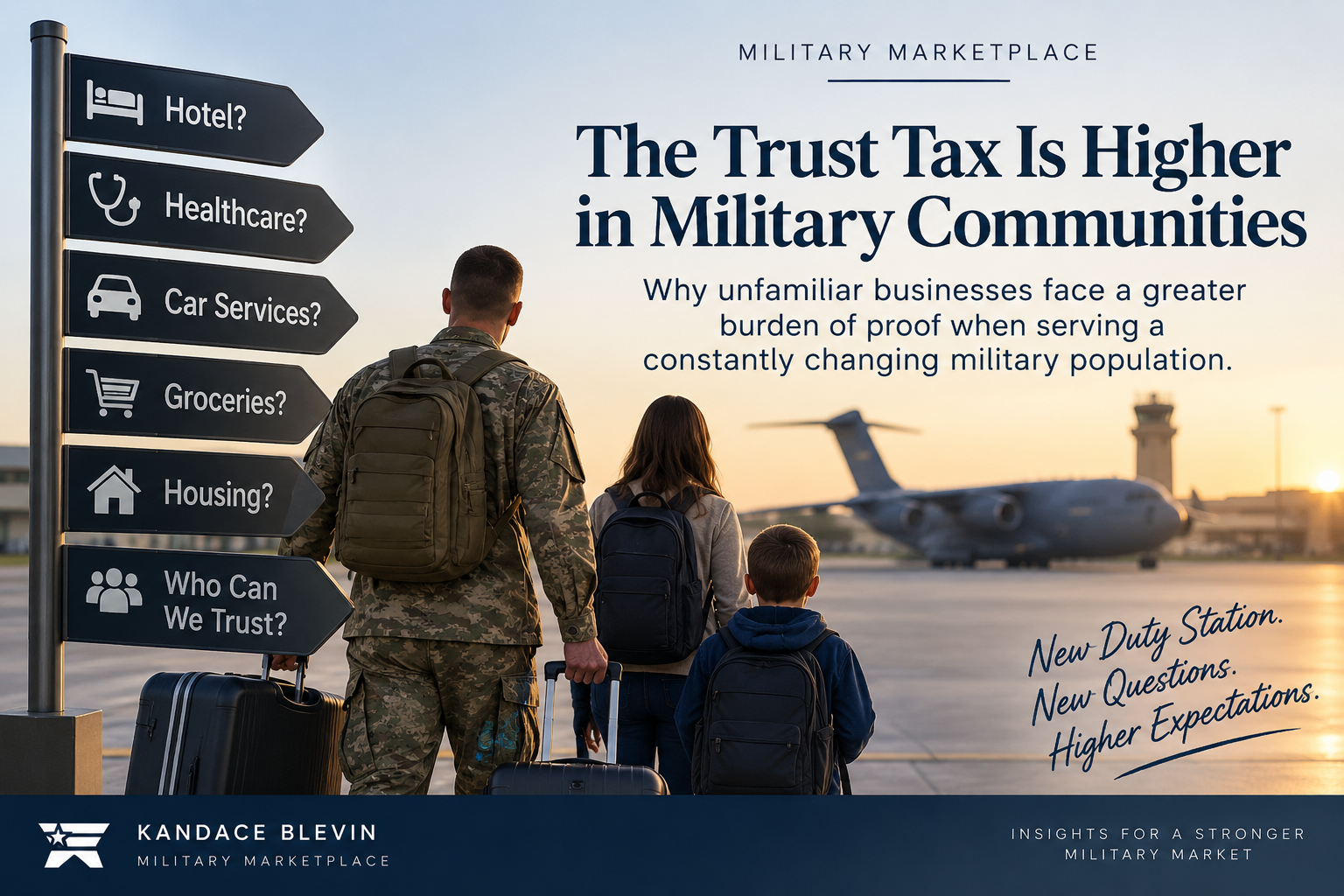
  • The Trust Tax Is Higher in Military Communities

    The Trust Tax Is Higher in Military Communities

    Why unfamiliar businesses face a greater burden of proof when serving a constantly changing military population


    Every business has to earn trust.

    When a customer encounters a company for the first time, there is inevitably some uncertainty. The customer does not yet know whether the business will deliver what it promises, whether the service will meet expectations or how the company will respond if something goes wrong. Established businesses have an advantage because years of visibility, reviews, recommendations and successful customer interactions have already answered some of those questions.

    I call the uncertainty an unfamiliar business has to overcome the trust tax.

    I first explored this idea in my Advisor’s Edge article, The Trust Tax: What New Businesses Pay That Established Brands Don’t. The premise was relatively simple: every unfamiliar business carries a higher burden of proof because customers have less evidence available to help them make a confident decision. As familiarity and credible evidence accumulate, that burden gradually decreases.

    In military communities, however, there is another dimension to the problem.

    Businesses are often introducing themselves to customers who are also being introduced to the market.

    A family arriving at Ramstein does not necessarily know which German businesses Americans routinely use. A servicemember arriving at Aviano may have no established relationship with local banks, hotels, restaurants or automotive services. Someone assigned to SHAPE may be navigating Belgium, military bureaucracy and a new local marketplace simultaneously.

    Even businesses that have operated near an installation for twenty years can therefore encounter customers who experience them as though they opened yesterday.

    That is why the trust tax can be considerably higher in military communities.


    Every PCS Cycle Resets Part of the Marketplace

    Most local businesses benefit from accumulated community knowledge.

    Residents learn which restaurant has been there for years, which mechanic their neighbors trust and which dentist seems to have treated everyone in town. That knowledge moves through families, workplaces and social networks. Over time, established businesses become part of the local landscape.

    Military communities operate differently because a significant portion of the population is continually rotating.

    People arrive. People leave. New assignments begin. PCS orders move families across states, countries and continents. With every cycle, some of the accumulated familiarity that businesses worked to establish walks out of the market and a new group of consumers arrives without it.

    That creates an unusual marketing challenge.

    A restaurant outside an installation may be extremely well known among people who have been stationed there for several years, while remaining completely unknown to a family that arrived three days ago. A veterinarian may have hundreds of satisfied American customers and still need to establish credibility with every new wave of pet owners. A university may have served military students for decades while each newly assigned servicemember encounters the institution for the first time.

    The business may be established, but the relationship is new.

    This is one reason sustained visibility matters so much in military markets. Businesses are continually rebuilding familiarity with a changing audience.


    Overseas Military Communities Add Another Layer of Uncertainty

    The trust tax becomes particularly interesting overseas because the consumer is often evaluating more than the business.

    They may also be evaluating the country, language, customs and unfamiliar commercial practices surrounding it.

    Consider an American family arriving in Germany and looking for a veterinarian.

    They may wonder whether the staff speaks English, whether the clinic understands the documentation required for military families traveling with pets, whether American credit cards are accepted, how appointments work and whether the experience will resemble what they are accustomed to in the United States.

    The veterinarian may be excellent. It may have operated successfully for thirty years and have an outstanding reputation among German customers.

    Yet the newly arrived American still has unanswered questions.

    The same dynamic can affect hotels, healthcare providers, financial institutions, insurance companies, restaurants, automotive businesses, tourism providers and many other categories serving military communities overseas.

    The customer is evaluating whether the business is trustworthy while simultaneously trying to determine whether it understands people like them.

    That additional uncertainty raises the burden of proof.

    Businesses that recognize this can reduce friction by making military relevance easier to establish. English-language information helps. Clear explanations help. Reviews from other military customers can help. A history of serving the community helps, particularly when that history can actually be discovered.

    This connects directly to the question I explored in my previous Military Marketplace article, What Does the Internet Tell the Military Community About Your Business?

    A reputation that exists primarily through local knowledge becomes less useful when the next customer has just arrived.


    Military Consumers Borrow Trust

    When people lack firsthand knowledge, they often borrow confidence from people and institutions they already trust.

    This happens everywhere, but military communities create particularly strong examples.

    A newcomer asks coworkers where they take their car. A spouse asks a community group for veterinarian recommendations. Someone sees the same hotel repeatedly mentioned by other Americans. A family receives a relocation publication during the arrival process and begins using it to understand the surrounding community.

    The recommendation does not have to close the sale. It simply reduces uncertainty enough for the consumer to investigate further.

    Trusted environments can work similarly.

    A business encountered through an established military-community resource begins with context that an unknown company appearing randomly online may lack. The consumer still evaluates the business, reads reviews, checks the website and makes an independent decision, but the initial encounter happens within an environment already associated with the community they are trying to understand.

    This is one of the reasons I believe military-market advertising should be evaluated through more than immediate clicks and conversions.

    Context matters.

    Where someone encounters a business can influence how that business is perceived.


    Familiarity Becomes Particularly Valuable When Time Is Short

    PCS also compresses decision-making.

    A newcomer may need certain services immediately. Hotels, transportation, mobile service, banking, insurance, restaurants and essential household purchases can become priorities within days of arrival. Healthcare, education, childcare, travel and other decisions follow as the family becomes established.

    Consumers do not necessarily have months to develop familiarity with every company they might use.

    Businesses therefore benefit when familiarity begins before the moment of need.

    Someone may see a company in a Welcome Guide during arrival. Later, they notice the same business on a military-community website. They encounter an advertisement, see a promotional item, hear the name from a coworker or notice positive reviews while searching online.

    None of those encounters necessarily produces an immediate sale.

    Together, however, they can change what happens when the need finally appears.

    Instead of evaluating a completely unknown company, the consumer recognizes the name.

    Recognition does not guarantee trust, but it reduces some of the uncertainty that makes an unfamiliar purchase feel risky. That was central to the original Trust Tax framework: repeated exposure and credible associations gradually turn an unknown organization into a familiar one.

    In military communities, the value of that process is amplified because the audience itself keeps renewing.


    Credibility Has to Be Visible

    There is another complication.

    A business can be highly credible without making that credibility easy for newcomers to see.

    Imagine a company that has served the Kaiserslautern Military Community since the 1990s. Perhaps thousands of Americans have used it. Local residents know the company. Long-term customers recommend it.

    Yet its website barely mentions military customers. Its Google profile contains incomplete information. Reviews provide little context. There are few independent references connecting the company to the military community.

    The credibility exists.

    A newcomer simply has difficulty seeing it.

    This is where the previous articles in this series begin connecting.

    In How the Military Community Discovers Businesses Today, I looked at the growing number of places where discovery occurs.

    In What Does the Internet Tell the Military Community About Your Business?, I examined the digital evidence consumers find after that discovery occurs.

    The trust tax explains why those things matter.

    Discovery creates the opportunity to be considered. Digital evidence helps the consumer evaluate what they have found. Repeated visibility, credible associations and positive experiences gradually reduce the uncertainty surrounding the decision.

    This is also where our later discussion of AI will become important.


    AI Is Becoming Another Participant in the Trust Process

    In the original Advisor’s Edge article, I argued that AI is reinforcing the importance of credibility because AI systems also need information from which to evaluate relevance and context. Businesses that leave behind a broader trail of reviews, articles, mentions and credible associations provide more information that can potentially be interpreted.

    For the military marketplace, that creates an interesting convergence.

    The newly arrived consumer is asking:

    Can I trust this business?

    Search engines and AI systems are trying to answer related questions:

    What is this business? Where is it? What does it do? Who does it serve? Is it relevant to what this person is asking?

    That does not mean AI evaluates trust exactly as a person does, and businesses should be wary of anyone promising that a particular tactic will guarantee AI recommendations.

    It does mean that businesses increasingly benefit from leaving behind a clear and credible record of who they are.

    The same reviews, accurate information, useful website content, independent references and credible community associations that help a military newcomer evaluate a business also create a richer digital footprint.

    Human trust and digital discoverability are beginning to overlap.

    That overlap will become increasingly important as consumers move from traditional search toward conversational discovery.


    How Businesses Can Lower the Military Trust Tax

    For a business trying to reach the U.S. military community, lowering the trust tax begins with recognizing the specific uncertainty your customer may be experiencing.

    Ask yourself what a newcomer would need to know before feeling comfortable choosing you.

    Then examine whether the evidence is available.

    Does your website make your military experience clear? Can customers easily determine where you are located and what communities you serve? Do reviews provide evidence that other Americans have successfully used your business? Are you visible in places military consumers already use for information? Does your business remain present throughout the year, or does it appear briefly during campaigns and then disappear?

    Most importantly, consider whether your marketing is creating a pattern.

    One advertisement creates an encounter. A recommendation creates another. A useful article adds context. A Welcome Guide appearance sitting in a rack on base or handed to a soldier at intake creates visibility during relocation. Programmatic advertising can maintain awareness across the wider digital environment. A promotional product may keep the company physically present. Positive customer experiences create reviews and word of mouth that continue after the advertising itself is gone.

    The original Trust Tax article made the case that credibility is usually built through accumulated evidence rather than a single interaction.

    Military communities make that accumulation especially valuable because businesses are continually introducing themselves to the next group of arrivals.


    Q&A: Trust and the Military Marketplace

    Do military consumers automatically trust businesses that advertise in military media?

    No. Consumers still evaluate businesses independently, and no advertising environment can substitute for good service, accurate information and a strong reputation. Appearing within familiar military-community environments can provide useful context and increase familiarity, particularly for newcomers who are still learning the local market.

    How long does it take to build familiarity in a military community?

    There is no universal timetable. Business category, purchase frequency, competition, location and advertising intensity all matter. The more important principle is continuity. Military populations rotate, so businesses benefit from treating familiarity as an ongoing process rather than a campaign that is completed once awareness has been achieved.

    Does this apply only to new businesses?

    No. An established local company can effectively be “new” to every incoming military consumer. This is one of the defining differences between traditional local marketing and military-market marketing.

    Can reviews alone establish trust?

    Reviews are extremely useful, but consumers often evaluate several kinds of information together. A credible website, accurate listings, recommendations, media presence, community visibility and consistent information can reinforce what reviews already suggest.


    A Final Thought

    The military marketplace creates an unusual paradox for established businesses.

    You can spend decades earning a reputation and still meet thousands of customers each year who have never heard your name.

    That means familiarity cannot simply be achieved and then maintained passively. Every PCS cycle introduces another audience that needs to discover who you are, understand why you are relevant and gather enough evidence to feel comfortable choosing you.

    For businesses serving military communities, the trust tax is therefore something that must continually be reduced.

    The companies that do this well remain visible. They make their experience easy to verify. They appear in credible environments. They give customers useful information before asking them to buy. Most importantly, they remain present long enough for individual encounters to become a recognizable pattern.

    Because in a community where the customer base continually changes, being established is valuable.

    Being recognized as established is even more valuable.


    Schedule a Strategy Session

    If your business is trying to reach the U.S. military community and you would like to explore how print, digital advertising, programmatic targeting, military-community media or promotional products could work together, please feel free to contact me through my Booking Calendar.

    I can help you evaluate the available options and determine which combination makes sense for your audience, location, objectives and budget.

    Kandace Blevin, Multimedia Consultant | Stars and Stripes

    Military Audience Strategy • Integrated Advertising • Digital Marketing

    Blevin.Kandace@Stripes.com | WhatsApp: +49 172-666-8134


    Related Articles

    From Military Marketplace

    From Advisor’s Edge

  • What Does the Internet Tell the Military Community About Your Business?

    What Does the Internet Tell the Military Community About Your Business?

    Why your digital footprint is becoming an increasingly important part of how military consumers evaluate your business


    Imagine arriving at a new duty station in another country.

    Within the first few weeks, you may need a hotel while you wait for housing, a veterinarian for your pets, a dentist who speaks English, a bank that understands American customers, a mechanic for your car and several restaurants where your family feels comfortable. If you have children, you may also be looking for schools, activities and healthcare providers. Before long, you will probably start thinking about weekend travel, shopping and the dozens of other services that gradually turn an unfamiliar location into home.

    For most of those decisions, you begin with very little local knowledge.

    You may search Google or Maps, ask coworkers for recommendations, read conversations in a military-community Facebook group, pick up a Welcome Guide during in-processing, visit StripesEurope.com, notice an advertisement, read reviews or ask an AI assistant to help you compare your options. Sometimes several of these things happen before you make a decision.

    Eventually, you encounter a business that seems promising and begin looking more closely.

    That is the moment I think businesses serving the U.S. military community should pay much more attention to, because being discovered is only the beginning of the process. Once someone finds your name, they begin gathering information about you, often from sources you do not directly control.

    What do they find about your business?

    Does your website clearly explain what you do and where you are located? Do your reviews support the impression created by your advertising? Does your Google Business Profile agree with your website? Can someone tell that you regularly work with Americans or serve a nearby military installation? Are there independent references to your business? If an AI assistant tries to understand your company, is there enough reliable information available for it to form an accurate picture?

    Taken together, these individual pieces of information create something much larger than a collection of profiles and marketing channels. They form your digital footprint, and that footprint increasingly influences how people understand your business before they ever contact you.


    Your Online Reputation Exists in More Places Than You Control

    Businesses naturally spend most of their attention on the digital properties they manage themselves. They build a website, maintain Facebook and Instagram pages, update a Google Business Profile and encourage satisfied customers to leave reviews. These are all important parts of a healthy online presence, particularly for a local business.

    The difficulty comes when a business begins to assume that maintaining those few business profile properties means the rest of its online reputation will take care of itself.

    A prospective customer rarely experiences your digital presence as neatly as you manage it. Someone searching for your company may encounter your Google listing first, followed by reviews, an old directory entry, your website, a Facebook page, an article mentioning your company and perhaps a Reddit or community-group discussion. Another person may discover you through an advertisement and search your name afterward. Someone else may receive a recommendation from a coworker and then spend ten minutes investigating you online before deciding whether that recommendation deserves their trust.

    AI adds another layer because consumers can increasingly ask technology to help assemble and interpret some of this information for them.

    This means that the story your business tells about itself is only one part of the picture. The information that exists around your business contributes to that picture as well.

    Consider a hotel near a U.S. military installation in Germany. Its website may state that American military travelers are welcome, which is certainly useful. Now imagine that reviews from American guests mention PCS stays and pets, the hotel provides clear English-language information, its location and contact details are consistent across major platforms, and military-community publications or resources have referenced the property over time.

    A newly arriving military customer now has several pieces of information pointing in the same direction. The hotel’s relationship with the community becomes easier to understand because the claim is supported by a broader digital history.

    That distinction will become increasingly important as the way consumers research businesses continues to evolve.


    Consistency Helps People and Technology Understand Your Business

    One of the most common digital problems is also one of the easiest to overlook:

    Information changes.

    A business moves. Telephone numbers change. Services expand. Opening hours are adjusted. A new owner takes over. A company that once primarily served local German customers begins actively working with Americans stationed nearby. Someone updates Google but forgets Facebook. The website still contains an old description. A directory that was created five years ago continues displaying outdated information.

    Eventually, the internet contains several slightly different versions of the same business.

    For a human being, this creates uncertainty. If Google says you close at 18:00 but your website says 20:00, which one is correct? If your Facebook page lists one telephone number and your website another, which should someone call? If your advertising says you serve the military community but nothing on your website explains how, a prospective customer may wonder whether that message was simply promotional language.

    For search and AI systems trying to interpret information about businesses, clarity also matters. The easier it is to establish what a business does, where it operates and how different pieces of information relate to the same organization, the more coherent its digital identity becomes.

    This is particularly relevant for companies that want to reach a specialized audience such as the U.S. military community.

    If you regularly serve military customers, your digital presence should make that relationship understandable. A hotel may explain policies relevant to PCS travelers. A university may clearly describe programs available to servicemembers and military spouses overseas. A veterinarian might provide information useful to Americans navigating pet requirements in Germany. A financial institution may explain which services are available to U.S. personnel stationed abroad.

    This is useful marketing because it answers real customer questions, while also creating clearer information about the relationship between the business and the community it serves.


    Credibility Develops Through a Larger Digital History

    There is another part of your online reputation that deserves attention because businesses cannot manufacture all of it themselves.

    Independent evidence matters.

    A company can describe itself as trusted, experienced or military-friendly on its own website. Consumers will naturally expect businesses to speak positively about themselves. Confidence often increases when they begin finding evidence elsewhere that supports what the company says.

    Reviews are one obvious example because they document other people’s experiences. Media coverage can provide another signal. So can professional associations, community involvement, interviews, directory listings, partnerships, articles, awards and references from credible organizations.

    For businesses serving military communities, this kind of history can be especially valuable because so many potential customers arrive without established local relationships.

    Someone who has lived in Kaiserslautern for five years may already know which restaurants they like, where they take their car and which dentist they trust. Someone who arrived at Ramstein two weeks ago does not have that accumulated knowledge. They have to borrow knowledge from other people and from the information they can find.

    That is why military-community visibility can have value beyond the initial advertising impression.

    A newcomer may first see a business in a Stars and Stripes Welcome Guide. Weeks later, they might encounter the same company online. Perhaps they see a programmatic advertisement or a sign on base, notice the business mentioned in an article, receive a promotional item or hear the name from a coworker. When they eventually need that particular service, the company is no longer completely unfamiliar.

    If they search for it at that point, the digital footprint becomes part of the evaluation process.

    Over time, these encounters and references create a history that a single advertisement or social post cannot replicate.


    AI Makes This Digital Evidence More Important

    The growth of AI-assisted discovery makes this discussion particularly timely because people are beginning to ask increasingly complicated questions about businesses and services.

    Traditional search trained us to reduce our needs to a few keywords. Someone looking for a hotel might type “hotel Ramstein Germany” and work through the results.

    Conversational AI allows that person to provide considerably more context.

    A family arriving on PCS orders could ask for hotels near Ramstein that accept dogs, accommodate children, have parking and are convenient for someone who has just arrived from the United States. A servicemember in Belgium might ask for an English-speaking dentist near SHAPE who regularly works with American patients. A military spouse could ask which universities offer flexible programs for Americans stationed overseas and then continue the conversation by comparing tuition, schedules or degree options.

    Those are much richer questions.

    They include location, circumstance, audience, preferences and intent, all at the same time.

    For a business to be relevant to such a question, there needs to be information available that helps establish those connections. The business’s website may provide some of it. Reviews may provide another piece. Business listings, articles, media references and other credible sources can contribute additional context.

    No business can force an AI system to recommend it, and recommendations can vary considerably among systems and queries. There is also no magic number of reviews, mentions or website pages that guarantees inclusion.

    What businesses can influence is the quality of the information environment surrounding them.

    A well-developed website can explain services and expertise. Accurate business profiles can establish location and operating information. Reviews can describe customer experiences. Independent references can provide additional context and credibility. Consistency among these sources can make the overall picture easier to interpret.

    For businesses that have spent years building a good reputation offline, this raises an interesting question: Does the internet contain enough evidence of the reputation you have already earned?

    In many cases, I suspect the answer is no.


    Look at Your Business Through the Eyes of a Newcomer

    One of the most useful exercises I recommend is periodically investigating your own business as though you had never heard of it.

    Start with your company name and see what appears. Then stop using the company name altogether.

    Search instead for the problem you solve.

    If you operate a hotel near Ramstein, search the way an American arriving in the area might search. If you are a university serving military students, look for programs using the questions a servicemember stationed overseas might ask. If you are a healthcare provider, veterinarian, restaurant, financial institution or travel company, imagine what someone unfamiliar with the local market would need to know before choosing you.

    Then try the same exercise with an AI assistant.

    Ask for recommendations in your category without mentioning your business. Add realistic military context to the question. See which businesses appear and, more importantly, investigate why those businesses may be easier to understand.

    You can then examine your broader digital footprint with several practical questions:

    • Does my website clearly explain what we do, where we operate and whom we serve?
    • Is our business information consistent across Google, our website, social platforms and major directories?
    • If serving the U.S. military community is important to us, is there meaningful evidence of that relationship online?
    • What do customers repeatedly say about us in reviews?
    • Are there independent articles, media references, affiliations or other credible sources that help establish our history and expertise?
    • If someone discovers us through an advertisement today and searches for us tomorrow, does what they find reinforce the impression we intended to create?

    You may find that you have hundreds of excellent Google reviews but a weak website. You may have a very active Facebook following while the broader internet contains little information about your business. Perhaps you have served military customers for fifteen years, yet almost nothing online documents that experience.

    These are valuable discoveries because they reveal where the digital version of your reputation has fallen behind the real one.


    What This Means for Military-Market Advertising

    This is also where the role of advertising begins to broaden.

    A campaign can certainly produce immediate exposure, traffic, inquiries or sales, depending on the channel and objective. There is also longer-term value in becoming a recognizable part of the environment where your customers live, work, research and make decisions.

    For military consumers, that environment spans digital, print, physical and interpersonal spaces.

    A Welcome Guide can introduce your company while someone is learning about a new duty station. Military-community websites and publications can reinforce that presence. Sponsored content can provide room to demonstrate expertise and answer questions that matter to the audience. Programmatic advertising can extend visibility across the wider digital environment. Promotional products can create repeated physical exposure long after the initial interaction.

    Word of mouth and reviews then add another dimension that the advertiser cannot purchase directly but can certainly earn.

    The value comes from understanding how these encounters relate to one another.

    A customer may see your advertisement today and have no immediate need for your service. Three months later, a friend mentions your company. The name sounds familiar. The customer searches for you, finds a professional website, reads strong reviews and discovers additional references that confirm you regularly serve the military community.

    That entire sequence contributes to the decision.

    As search, AI and traditional discovery channels become more interconnected, businesses should think about visibility as something that develops over time and across environments. Each encounter provides another opportunity for someone to recognize the company, understand what it offers and develop confidence in its relevance.


    Q&A: Your Digital Footprint and the Military Market

    Is a strong Google Business Profile still important?

    Very much so, particularly for local businesses. Google Search and Maps remain important ways people discover services around them, and accurate information, photos and reviews can strongly influence a customer’s first impression. The broader opportunity is to ensure that someone who moves beyond your Google profile finds an equally credible and consistent presence elsewhere.

    Can Facebook or Instagram serve as my primary business website?

    For some very small businesses, social media may be where most customer interaction occurs, and those platforms can be extremely useful. An owned website, however, gives you considerably more control over how your services, expertise, location and audience are explained. It also creates a stable digital property that is not dependent on the structure or policies of a social platform.

    Can I make ChatGPT or another AI assistant recommend my business?

    There is no legitimate way to guarantee an organic AI recommendation. What a business can do is make accurate, useful and credible information about itself easier to find and understand across the web. As AI-assisted discovery develops, that is a sensible investment regardless of which individual platforms ultimately become dominant.

    Should businesses still invest in traditional media if consumers are moving toward AI?

    Yes, particularly when the medium reaches the right audience at the right point in their lives. A military newcomer reading a relocation guide is a very different audience opportunity from a generic online impression. Print, military-community media, digital advertising, programmatic campaigns, sponsored content and promotional products can each play different roles in creating familiarity and supporting the broader customer journey.


    A Final Thought

    Businesses spend a great deal of time thinking about what they want customers to know about them. Increasingly, it is worth spending equal time examining what customers can actually discover.

    For companies serving the U.S. military community, that distinction matters because the market is continually renewing itself. Every PCS cycle brings people who do not yet know the local businesses, the established reputations or the names everyone else takes for granted. They have to build that knowledge for themselves, and much of that process now happens through the information they can access online.

    A strong reputation developed over ten or twenty years is enormously valuable. The challenge is making sure the digital world reflects enough of that history for someone arriving tomorrow to recognize it.

    Search your business. Read what others say. Ask AI about your category. Look at your website through the eyes of someone who arrived in the country last week. Follow the trail wherever it leads.

    Because once a military consumer discovers your business, the next question is what the rest of the internet tells them about you.


    Schedule a Strategy Session

    If your organization wants to reach the U.S. military community and you would like to explore how military-community media, print, sponsored content, programmatic advertising or promotional products can contribute to a broader visibility strategy, I would be happy to discuss the options with you.

    Use my Booking Calendar to schedule a strategy session, and we can look at your audience, location, objectives and existing visibility to determine which approaches make sense for your business.

    Kandace Blevin, Multimedia Consultant | Stars and Stripes

    Military Audience Strategy • Integrated Advertising • Digital Marketing

    Blevin.Kandace@Stripes.com | WhatsApp: +49 172-666-8134


    Related Articles

    From Military Marketplace

    From Advisor’s Edge

  • The Trust Tax: What New Businesses Pay That Established Brands Don’t

    The Trust Tax: What New Businesses Pay That Established Brands Don’t

    How familiarity reduces friction and why credibility compounds over time.

    Executive Summary

    Every business enters the market as an unknown. Before customers can meaningfully evaluate pricing, features, or expertise, they must decide whether engaging with the business feels like a reasonable risk.

    That uncertainty creates friction. It slows decisions, raises the burden of proof, and makes every sales conversation more difficult. The challenge for new and growing businesses is therefore not simply to become visible, but to become familiar.

    Consistent visibility, credible associations, and repeated exposure gradually give customers the evidence they need. Recognition develops into confidence, and confidence can eventually become trust. As that happens, marketing becomes more efficient because customers no longer feel they are taking a chance on an unknown organization.

    This helps explain why established brands often outperform newer competitors even when the newer business offers a better product or service. Familiarity reduces friction, but it must be earned one credible interaction at a time.


    The Invisible Cost of Being Unknown

    Most businesses understand the costs that appear on a financial statement. Payroll, inventory, advertising, software, rent, and insurance can all be measured and planned for with reasonable precision. Being unknown creates another kind of cost, one with no invoice and no tidy place on a balance sheet, yet it influences how quickly customers decide and how hard a business must work to win them.

    Every new business pays what might be called a trust tax. It is paid in longer sales cycles, greater scrutiny, additional reassurance, and opportunities lost to competitors whose names customers already recognize. The tax does not necessarily reflect the quality of the business. A new company may be more capable, responsive, or innovative than an established rival, but those qualities have little commercial value until prospective customers have enough evidence to believe them.

    Consider two companies offering similar solutions at comparable prices. One has served the market for years; the other opened recently. The newer company may be the better choice, yet the established company begins with an advantage accumulated through time. Customers have seen its name, encountered it in different settings, or watched others do business with it. Its continued presence suggests stability. Choosing it feels less like an experiment.

    This is the hidden value of familiarity. It does not prove that a company is superior, but it makes the company easier to evaluate. The unknown business must first establish that it is real, capable, and likely to remain available if something goes wrong. The familiar business has already answered some of those questions simply by being present long enough for customers to recognize it.


    How Customers Reduce Risk

    This preference for the familiar is not irrational. Modern customers often buy from companies they have never visited and hire people they have never met. Their decisions may depend almost entirely on websites, reviews, search results, articles, videos, recommendations, and social profiles. Much of that information has been selected or produced by the business itself.

    Professional presentation is also easier to manufacture than it once was. A polished website can be built quickly. Convincing copy, imagery, and video can be produced with relatively modest resources, and generative AI has further lowered the cost of appearing established. Presentation still matters, but it no longer provides the same reassurance when almost any organization can create it.

    Customers compensate by looking for corroboration. They read reviews to see not only whether a company satisfies people, but how it responds when something goes wrong. They look for recent activity, recommendations, independent mentions, and evidence that other people have interacted with the business successfully. They are trying to determine whether the impression created by the company is supported by a wider record.

    Continuity carries particular weight. A business that appears repeatedly over several years communicates stability without explicitly claiming it. Customers may reasonably infer that it has survived changing conditions, maintained relationships, and continued delivering enough value to remain in operation. Those conclusions are not infallible, but they give customers a practical shortcut when complete certainty is impossible.

    Established brands benefit from this accumulated reassurance. Their advantage is often attributed to larger advertising budgets or greater market share, but longevity itself has commercial value. The established business is no longer introducing its existence each time it enters a sales conversation. The newer business is still asking customers to accept a larger measure of uncertainty before its product, service, or expertise can be judged on equal terms.


    From Visibility to Familiarity

    Visibility begins to close that gap, although exposure alone is not enough. A business can attract attention without becoming credible, just as it can become recognizable for the wrong reasons. The value lies in repeated, coherent appearances that give customers a stable impression of who the business is, what it offers, and whether its behavior supports its claims.

    A prospective customer might first notice the company in an advertisement, later encounter its name in an article, and eventually hear it recommended by a colleague. No single appearance determines the decision. Together, however, they form a pattern. The company begins to occupy a recognizable place in the customer’s understanding of the market.

    This is why awareness and trust should not be treated as interchangeable. Awareness is the moment a business enters someone’s attention. Familiarity develops when that business continues to appear in relevant and credible contexts. Trust comes later, after those encounters have been reinforced by consistency, third-party validation, or direct experience.

    The process is gradual enough to be easy to underestimate. Customers rarely remember every advertisement, article, or mention that shaped their perception. They are more likely to remember the resulting sense that they have heard of the company before. That recognition reduces the cognitive work of evaluating it and makes further consideration feel less risky.

    Visibility, then, is not merely a branding exercise or a vanity metric. It is part of the infrastructure through which a business becomes knowable. Lead generation and conversion remain important, but they measure outcomes near the end of a process that may have begun months earlier. Long before a customer acts, consistent visibility has been establishing the context in which that action becomes possible.


    The Cost of Starting Over

    This longer process sits uneasily beside the way many organizations evaluate marketing. Campaigns are launched and judged within quarterly reporting cycles. Leaders examine traffic, leads, and sales, then ask whether the investment worked. The question is reasonable, but the time frame may capture immediate response while missing the development of familiarity.

    A campaign can be doing useful work before it produces an obvious sale. Prospective customers may be encountering the company for the first time, learning what it offers, or beginning to recognize its name. These are early effects rather than final outcomes, and they are difficult to value on a conventional performance report.

    Impatience often interrupts that progress. When immediate results disappoint, organizations change the message, abandon the platform, or replace the strategy. Each decision may appear responsive when viewed internally. To the audience, however, the business simply disappears before it becomes familiar, then returns in a different form and begins another introduction.

    This creates a costly cycle of reinvention. The organization continually plants the first seeds of awareness but rarely allows them to develop into recognition. It interprets the absence of immediate conversion as evidence that the campaign failed, even though the larger problem may be that no campaign remained coherent and visible long enough to establish a pattern.

    Consistency should not become an excuse to preserve ineffective marketing. A campaign that reaches the wrong audience, carries a weak proposition, or uses an unsuitable channel still needs correction. The distinction is between informed refinement and reflexive abandonment. Businesses need enough continuity to determine whether a strategy is failing or simply performing an earlier function than the metric being used to judge it.


    Credibility Compounds

    The trust tax declines as credible evidence accumulates. A positive review, a successful customer interaction, a referral, a case study, or an informed article each contributes something different. None is decisive on its own, but signals that reinforce one another begin to create a coherent record.

    Third-party environments can accelerate this process because they provide context the business cannot create entirely for itself. An appearance in a respected publication, industry resource, professional association, or established community places the company alongside institutions the audience already knows. That association does not transfer trust automatically, but it offers a form of validation that self-promotion alone cannot provide.

    The strongest effect comes when visibility and performance support each other over time. Marketing makes the business recognizable; customer experience confirms or challenges the impression marketing created. Reviews and recommendations extend that experience beyond the original customer. Continued presence shows that the organization has not vanished after a brief burst of promotion. Each layer strengthens the others.

    This is how credibility compounds. Early interactions require more effort because the business has little accumulated evidence behind it. Later interactions benefit from everything that came before. Prospective customers arrive with some context, sales conversations begin further along, and marketing no longer has to establish the company’s existence before communicating its value.

    In that sense, established brands have not escaped the trust tax. They have paid it down through years of visibility, delivery, and continuity. Newer organizations cannot eliminate the passage of time, but they can use that time deliberately by creating a consistent record rather than a series of disconnected impressions.


    Trust in an AI-Mediated Market

    AI is reinforcing the value of that record, although not because algorithms experience trust as people do. AI-assisted search and recommendation systems depend on the information available to them. A business represented only by claims on its own website offers a narrower and less independently supported picture than one discussed across credible, relevant sources.

    This creates an important overlap between human judgment and machine-mediated discovery. People look for corroboration because they want reassurance. Information systems look for patterns, relationships, and supporting context because those signals can help them organize and surface useful results. The processes are not identical, but both favor businesses that leave a coherent trail beyond their own promotional channels.

    Reviews, articles, interviews, media mentions, professional profiles, and consistent business information all contribute to that trail. Their value is not simply that each might attract an audience directly. Together, they make the organization easier to understand, verify, and place within its market.

    No business can guarantee how an AI system will interpret or recommend it, and visibility should not be built around speculative promises of algorithmic favor. The practical principle is more durable: credible evidence distributed across relevant environments improves the information available about the organization. That helps people evaluate it today and makes it more legible within the systems increasingly mediating what people find tomorrow.


    The Long Value of Being Present

    The trust tax explains why excellent products do not always win quickly and why established competitors retain an advantage even when their offerings are less compelling. Customers are not evaluating quality in isolation. They are deciding how much uncertainty they are willing to accept before quality can be tested.

    Consistent visibility narrows that uncertainty by giving customers a history to observe. Familiarity makes the business easier to consider, credible associations make its claims easier to believe, and positive experiences turn recognition into confidence. None of this happens through a single campaign or a dramatic moment of persuasion. It develops through continuity.

    For that reason, the most productive marketing question is not always whether one appearance produced an immediate sale. It may be whether the organization is building a recognizable and credible presence that makes every future decision easier. Performance matters, but so does the accumulated context in which performance occurs.

    Businesses that understand this are less likely to chase constant novelty or mistake motion for progress. They refine their strategy without repeatedly erasing it. They remain visible in places that reinforce their legitimacy and allow each credible interaction to add to the last.

    Over time, the business no longer feels new to the people it hopes to serve. Sales conversations begin with recognition rather than introduction, and marketing works with the advantage of an established impression rather than against the resistance of an unknown name. The trust tax has not vanished by accident. It has been paid down through the patient accumulation of evidence.

    The strongest organizations are not always those that make the loudest entrance. More often, they are the ones that remain present, credible, and consistent long enough to become part of how customers understand the market. Visibility earns its greatest value when it stops feeling like promotion and starts functioning as proof that the business is here to stay.


    — Kandace Blevin, Advisor’s Edge™ Visibility Wins.

    This article is part of the AI Discovery series examining how AI search, recommendations, and large language models are changing the way organizations are found and evaluated.

    Kandace Blevin is the author of Advisor’s Edge, where she writes about AI discovery, visibility strategy, programmatic advertising, audience intelligence, and military market trends. She also helps organizations reach U.S. military audiences through trusted media and strategic planning.

    Book a Consultation: Calendar Link


    Related Articles

    The trust tax does not exist in isolation. It sits within a broader visibility ecosystem shaped by reputation, familiarity, credibility, and discoverability. The articles below examine those interconnected themes in greater detail.

    Latest Posts

  • Why Most Businesses Aren’t Showing Up in AI Search, And How to Fix It

    Why Most Businesses Aren’t Showing Up in AI Search, And How to Fix It

    Artificial intelligence doesn’t recommend businesses it can’t confidently understand.

    Kandace Blevin

    Kandace Blevin

    Marketing Strategist & International Multimedia Advertising Consultant | Stars and Stripes Europe Theater | Military Audience Strategy | AI-Era Visibility | Strategic Advisor


    Executive Summary

    Many business owners assume they are missing from AI search because they haven’t mastered the latest technology. They worry about algorithms, prompts, or optimization techniques, believing visibility depends on discovering the newest tactic before everyone else.

    The reality is usually much simpler.

    Artificial intelligence recommends businesses it understands. Before AI can decide whether an organization deserves to appear in a recommendation, it must first develop confidence about what that business does, whom it serves, and why someone should choose it. When those answers remain unclear or inconsistent across a company’s digital presence, AI becomes hesitant to recommend it.

    This isn’t a technical problem nearly as often as it is a communication problem. Businesses that communicate a clear, consistent identity across their digital footprint become easier for both customers and AI systems to recognize, understand, and recommend.


    AI Cannot Recommend What It Cannot Understand

    One of the questions I hear most often from business owners is remarkably straightforward.

    “Why doesn’t AI ever recommend my business?”

    The assumption behind the question is that something must be wrong with the technology. Perhaps the website needs additional optimization. Perhaps Google changed its algorithm. Perhaps ChatGPT favors larger companies.

    Sometimes technical issues exist.

    Far more often, however, the business simply hasn’t made itself easy to understand.

    Artificial intelligence doesn’t experience your company the way you do. It doesn’t know your history, your expertise, or your reputation within the local community. Instead, it assembles information from your website, customer reviews, business listings, published articles, social media, and countless other public sources before attempting to answer a surprisingly simple question.

    “If someone asked me what this business does, could I answer confidently?”

    That question lies at the center of modern visibility.


    Clarity Is the Beginning of Visibility

    Business owners often describe their organizations using language that feels meaningful because they already understand the business.

    Customers don’t.

    Neither does AI.

    Phrases such as “innovative solutions,” “personalized service,” or “meeting your unique needs” may sound professional, but they tell neither people nor AI very much. Those statements could apply to almost any company in almost any industry.

    Specificity creates confidence.

    Imagine two businesses serving the military community around Ramstein.

    One says:

    “We provide exceptional services for military families.”

    The other says:

    “We help newly arrived U.S. military families near Ramstein find English-speaking healthcare providers.”

    The difference is not simply better copywriting.

    The second business has made itself understandable. Customers immediately recognize who the organization serves, what problem it solves, and why it exists. Artificial intelligence benefits from that same clarity because it has much stronger evidence upon which to build its understanding.


    AI Looks for Patterns, Not Individual Pages

    Many organizations still approach digital marketing one platform at a time.

    They update the website.

    Occasionally post on LinkedIn.

    Respond to reviews when time permits.

    Refresh the Google Business Profile every few months.

    Each activity appears independent because different platforms manage them separately.

    Artificial intelligence doesn’t see separate platforms.

    It sees one business.

    If your website describes one audience while your social media focuses on another, if your business listings use different terminology than your published content, or if customer reviews consistently highlight strengths your own marketing never mentions, AI notices those inconsistencies.

    Customers often notice them too.

    The issue is rarely that any single platform performs poorly. The issue is that the combined evidence tells an incomplete story.


    Visibility Is Built Through Repetition

    Business owners frequently ask how much content they should publish.

    The better question is what that content consistently communicates.

    Artificial intelligence learns through repeated patterns. Every article, customer review, directory listing, social media update, interview, and webpage contributes another opportunity to reinforce your identity. Over time those repeated signals make your expertise easier to recognize because they consistently describe the same organization serving the same audience with the same strengths.

    This is one reason many smaller businesses unintentionally struggle in AI-driven discovery.

    Their content changes direction every few weeks. One month they emphasize commercial clients. The next month they focus on residential work. Social media discusses one topic while the website highlights another. Reviews describe strengths that never appear anywhere else.

    None of those decisions seems significant in isolation.

    Together they create uncertainty.


    Why This Matters So Much in Military Communities

    Businesses serving military families face an additional challenge.

    Military customers relocate frequently, often know very little about the local community, and must make important decisions within compressed timelines. They rarely have the benefit of years spent developing trusted local relationships.

    As a result, they depend heavily on digital information.

    Whether they search through Google, ask AI for recommendations, compare reviews, or visit business websites, they are trying to answer the same fundamental question.

    “Can I trust this business?”

    Organizations that consistently communicate who they serve, demonstrate relevant expertise, and maintain accurate information across every digital touchpoint make that decision easier.

    Artificial intelligence rewards those same signals because they reduce ambiguity.


    Visibility Is Earned Before It Is Requested

    Many businesses approach visibility as though it begins when someone types a search.

    In reality, visibility begins long before that moment.

    Every customer review, every article, every accurate business listing, every interview, every community partnership, and every helpful piece of content contributes another signal helping both customers and AI understand who your organization is.

    Artificial intelligence simply assembles those signals faster than people can.

    That means businesses should spend less time trying to outsmart algorithms and more time building a digital identity that consistently reinforces the same message wherever customers encounter it.


    Final Perspective

    Business owners often ask how to become more visible in AI search.

    The answer rarely begins with artificial intelligence.

    It begins with clarity.

    Organizations that communicate a specific purpose, consistently reinforce their expertise, and maintain a coherent digital presence become easier for customers to understand. Artificial intelligence rewards that same clarity because it reduces uncertainty and increases confidence in the recommendations it provides.

    The businesses that appear most often in AI-driven discovery are not necessarily those with the largest marketing budgets or the most sophisticated technology.

    More often, they are the businesses that have made themselves unmistakably clear.

    Because AI cannot recommend a business it does not understand.

    And clarity is the foundation upon which every other visibility strategy is built.

  • Why Visibility Is Changing and Why Small Businesses Can’t Ignore AI

    Why Visibility Is Changing and Why Small Businesses Can’t Ignore AI

    Visibility is no longer something businesses buy. It is something they build.

    LinkedIn profile banner featuring Kandace Blevin, international multimedia advertising consultant, marketing strategist, and author of Advisor's Edge.
    Helping organizations navigate military audiences, AI-era visibility, and long-term marketing strategy.

    Executive Summary

    For decades, visibility followed a familiar pattern. Businesses invested in advertising, improved their search rankings, or relied on referrals, believing that if enough people discovered them, customers would eventually follow. While those approaches still matter, they no longer describe how purchasing decisions are actually made.

    Today’s customers move through an interconnected system of search engines, AI assistants, online reviews, business listings, websites, media coverage, social platforms, and personal recommendations before deciding whom to trust. Artificial intelligence has not replaced these channels. Instead, it has begun interpreting the signals flowing between them, rewarding organizations that present a clear, credible, and consistent picture of who they are.

    Understanding that shift requires more than learning another marketing tactic. It requires thinking differently about visibility itself. Businesses that continue treating visibility as a collection of isolated channels will find themselves working harder for diminishing returns. Those that understand how modern discovery works will build an advantage that compounds over time.


    Visibility Has Become a System

    For years, marketing conversations revolved around individual channels. One business focused on search engine optimization. Another invested in social media. Others relied primarily on referrals, email campaigns, newspaper advertising, or word of mouth. Each tactic was viewed as a separate activity with its own objectives and measurements.

    That way of thinking made sense when customers typically discovered businesses through one dominant source. Today, however, very few purchasing decisions begin and end in a single place.

    Imagine someone relocating to Germany after receiving military orders. They may begin with a Google search for a pediatrician near Ramstein. Before making an appointment, they read online reviews, visit the practice’s website, compare office hours, look for photographs of the facility, check whether the physician accepts their insurance, and perhaps even ask an AI assistant to recommend practices that appear reputable.

    None of those interactions determines the outcome by itself. Together, however, they create confidence.

    That is what visibility has become.

    It is no longer a collection of marketing activities operating independently. It is an interconnected system in which every customer interaction contributes another signal that helps people decide whether an organization deserves their trust.


    AI Didn’t Replace Search. It Changed Discovery.

    Much of the current discussion surrounding artificial intelligence focuses on whether AI will eventually replace traditional search engines.

    That debate misses the more interesting development.

    Artificial intelligence is not simply providing answers. It is increasingly interpreting information gathered from across the web and presenting businesses within a broader context. Search engines still matter. Websites still matter. Reviews still matter. Local listings, citations, media coverage, and reputation still matter. AI draws from those signals rather than replacing them.

    The practical implication is significant. Businesses can no longer optimize one channel while neglecting the others. Customers and AI alike evaluate organizations by looking for consistency. When the information agrees across multiple sources, confidence increases. When it conflicts or appears incomplete, uncertainty grows.

    Visibility has become cumulative. Every accurate listing, helpful article, positive review, professional website, and satisfied customer contributes another piece of evidence supporting the business’s credibility.


    Customers Don’t Follow Marketing Funnels

    One of the unintended consequences of digital marketing has been the belief that customers follow predictable funnels. Discover the business. Visit the website. Make a purchase.

    Real life is rarely that orderly.

    People move back and forth between platforms, gather information from multiple sources, ask friends for recommendations, consult AI, revisit websites, compare competitors, and often pause the decision entirely before returning days or weeks later.

    Each step either reinforces confidence or introduces doubt.

    Businesses sometimes wonder why advertising fails to produce immediate results. Often, the advertising itself is not the problem. Somewhere else in the customer’s journey, uncertainty remains unresolved. Perhaps the reviews are outdated. Perhaps the website fails to answer common questions. Perhaps the business appears legitimate in one place but inconsistent in another.

    Marketing rarely succeeds in isolation because customers no longer make decisions in isolation.


    Why This Matters Even More for Small Businesses

    Large organizations possess one enormous advantage.

    They have accumulated years of familiarity.

    Customers recognize their names, have seen them repeatedly, and generally assume they will still be operating tomorrow. That familiarity reduces uncertainty before a prospective customer even begins comparing products or services.

    Small businesses rarely enjoy that luxury.

    Every interaction must accomplish two objectives simultaneously. The business must explain what it offers while also establishing that it deserves consideration in the first place. Artificial intelligence has not created this challenge, but it has made it more visible by evaluating businesses through the same signals customers already use.

    This is why local businesses should not think about AI as another marketing platform requiring a separate strategy. AI simply rewards the organizations that have already done the difficult work of building credibility across the broader visibility ecosystem.


    Visibility Is an Investment That Compounds

    Perhaps the most important lesson for business owners is that visibility behaves much like reputation. It accumulates gradually through consistent effort rather than dramatic moments.

    Every customer review, every accurate business listing, every useful article, every positive interaction, every community partnership, and every professional webpage contributes another signal that strengthens future discovery.

    No single activity transforms a business overnight.

    Collectively, however, these efforts reduce friction every time someone encounters the organization. Customers spend less time questioning whether the business is legitimate and more time evaluating whether it is the right fit for their needs.

    Over time, that distinction becomes increasingly valuable because organizations no longer begin every customer relationship from a position of uncertainty.


    Final Perspective

    Businesses often ask how they should adapt to artificial intelligence.

    That is an understandable question, but it assumes AI is introducing an entirely new set of rules.

    In many respects, it is simply reinforcing principles that have always mattered.

    Organizations that communicate clearly, maintain accurate information, earn positive reputations, demonstrate expertise, and remain consistently visible have always enjoyed an advantage over those that do not. Artificial intelligence has simply become another participant interpreting those signals alongside human customers.

    The businesses that thrive over the coming years will not be those chasing every algorithm or every new technology. More often, they will be the organizations that understand visibility as an interconnected system rather than a collection of disconnected marketing tactics.

    Visibility is no longer something businesses purchase.

    It is something they build.

    And like every worthwhile investment, its greatest returns are realized through consistency over time.