
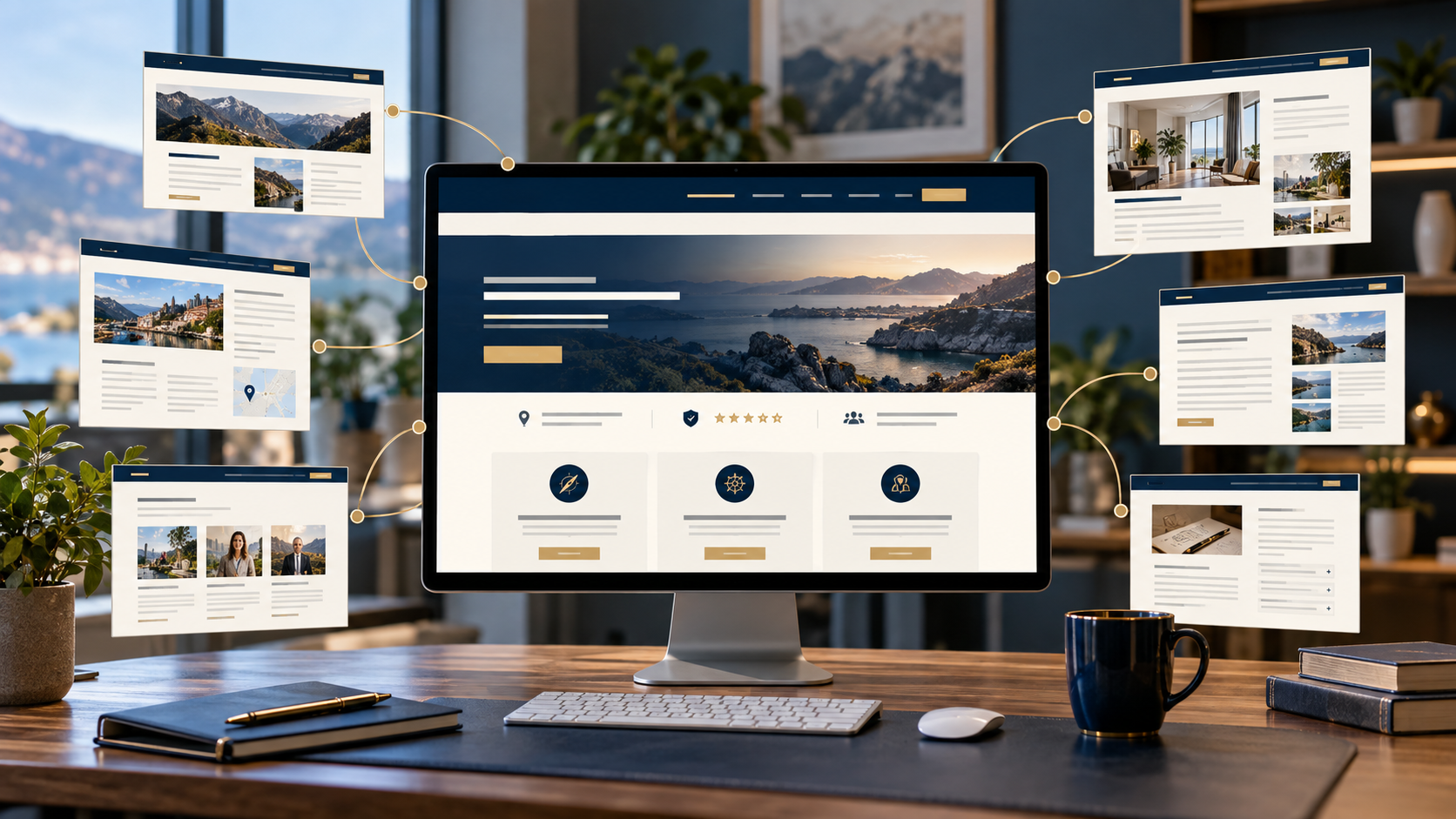
How a clear, credible homepage helps people and search systems understand your business, navigate your website, and find the right information.
Executive Summary
A homepage serves as the primary orientation point for many business websites. It should explain what the organization does, identify the audiences or markets it serves, establish credibility, and direct visitors toward detailed information. These functions matter to human visitors and can also help search engines understand the organization represented by the site.
The homepage is not the only page that contributes to AI-assisted discovery. Search systems can surface service pages, location pages, articles, product pages, and other crawlable content that directly addresses a query. The strongest website combines a clear homepage with a logical structure, substantive interior pages, accurate business information, appropriate structured data, and unrestricted access for the search crawlers the organization wants to reach.
The Homepage Has Become an Orientation Layer
For many years, homepage design was dominated by branding. Businesses wanted a dramatic image, a memorable slogan, and a visual presentation that created a strong first impression.
Those elements still have value, but appearance alone cannot carry the page. A visitor arriving from search, social media, advertising, an AI-generated answer, or a referral needs to understand the business quickly. The homepage must provide enough context to confirm that the visitor has reached a relevant and credible organization.
Search systems also benefit from explicit information. A clear business description, understandable headings, logical internal links, and consistent organizational details make the site easier to interpret and navigate. The homepage can help establish that context, especially when it connects cleanly to more detailed pages.
This makes the homepage an orientation layer for the site. It introduces the organization and provides a reliable route to the information that supports a visitor’s specific need.
AI Search Does Not Depend on the Homepage Alone
The homepage should not be treated as a page that single-handedly proves a business deserves to be recommended. AI-assisted search systems may retrieve information from any accessible page they consider relevant to the question.
A person asking about emergency dental treatment may be directed to a service page describing emergency care. Someone researching a particular location may encounter a location page. A detailed article may surface for an informational question even when the homepage says little about that exact topic.
The homepage still plays an important supporting role. It helps clarify the identity behind those pages, provides broader organizational context, and allows visitors to verify that the content belongs to an active and legitimate website.
The most reliable strategy is therefore site-wide clarity. The homepage introduces the organization, while individual pages provide the depth needed to answer specific questions.
Start With a Literal Explanation of the Business
The first prominent heading should help visitors understand the nature of the business. A slogan such as “Experience the Difference” may sound polished, but it does not explain what kind of difference is being offered or who might benefit from it.
A more useful heading identifies the service, audience, or market in direct language. For example, “Family dental care for the Kaiserslautern military community” communicates a business category, a service area, and an intended audience.
The heading does not need to carry every detail. A supporting sentence can explain the primary services, geographic reach, or central value. Together, the headline and introduction should answer the visitor’s first question: “Have I arrived at a business that can help me?”
Identify Who You Serve Without Excluding Everyone Else
Businesses serving a defined market should state that clearly. A relocation company may specialize in Americans moving to Germany. A university may serve military-connected students across Europe. A healthcare provider may accept specific insurance commonly used by the local military community.
That information helps visitors evaluate relevance and gives search systems clearer language with which to associate the business. However, audience descriptions should remain accurate and proportionate. A business should not imply exclusive access, official affiliation, or specialized expertise that it cannot substantiate.
Audience language should also avoid becoming so narrow that other legitimate customers assume they are unwelcome. The homepage can identify the primary market while the service pages explain who is eligible, what languages are available, and which practical requirements apply.
Provide a Useful Overview of Core Services
A homepage should present the organization’s main areas of work without attempting to reproduce every service page. A concise set of service cards or short descriptions can provide visitors with an immediate overview and a clear path to additional detail.
Each service should link to a dedicated page whenever the subject requires more explanation. That page can address eligibility, process, pricing considerations, geographic availability, common questions, and the action a prospective customer should take next.
This structure benefits both people and search systems. The homepage communicates the broad scope of the organization, while the linked pages provide specific information relevant to individual searches.
A long, unstructured paragraph containing every possible service is less helpful than a short overview connected to well-developed interior pages. Clarity comes from organization as much as wording.
Make Location and Service Area Unmistakable
Location matters whenever customers need to visit a physical site or determine whether a business serves their area. A homepage should identify the city, region, installation area, or broader territory in clear language.
Businesses serving military communities overseas may need additional context. A location described only by a German municipality may not immediately tell an American newcomer that it is near Ramstein, Vogelweh, SHAPE, Rota, or another familiar installation. Providing both the formal location and the commonly understood service area can reduce confusion.
Remote and mobile businesses should be equally precise. “Serving customers throughout Germany,” “Remote appointments available across Europe,” or “On-site service within the Kaiserslautern area” provides more useful information than a vague claim of worldwide availability.
The address and service area should also agree with the information shown on business profiles, directory listings, contact pages, and other official sources. Conflicting details create practical problems for customers and make the organization more difficult to verify.
Use Trust Signals That Can Be Verified
A homepage can establish credibility through factual and verifiable information. Depending on the organization, this may include professional credentials, years of experience, recognized memberships, client categories, security or privacy practices, accepted insurance, languages spoken, or links to independently hosted reviews.
Testimonials can reassure human visitors, but they should be genuine, current, and presented with appropriate context. A business should not publish an aggregate rating it cannot substantiate or use structured data to make unsupported claims about reviews.
Trust also develops through the ordinary details of a functioning website. Secure browsing, working links, current information, clear policies, accessible contact methods, and consistent branding all contribute to the impression that the organization is active and professionally managed.
No single badge or testimonial guarantees greater visibility. Credibility is cumulative and should extend beyond the homepage to the rest of the site and the organization’s external presence.
Give Visitors an Obvious Next Step
Once a visitor understands the business, the homepage should make the next action clear. That action may be viewing services, requesting an appointment, checking eligibility, obtaining directions, reading current articles, or contacting the organization.
The primary call to action should match the customer’s likely readiness. A visitor learning about an unfamiliar professional service may need more information before being asked to schedule a consultation. A customer seeking an urgent repair may need a phone number immediately.
A homepage can include more than one route, but competing buttons should not overwhelm the page. The most important action should be visually clear, while secondary links help visitors who need additional information first.
Structured Data Can Clarify Business Identity
Structured data provides search engines with standardized information about a page and the entity it represents. Depending on the website, the homepage may be an appropriate place for Organization, LocalBusiness, or WebSite markup.
This markup can identify details such as the organization’s name, canonical website address, logo, telephone number, address, and related profiles. Local business markup may also describe hours, departments, and other location-specific details when they apply.
Structured data should match information that visitors can verify on the website. It does not compensate for thin content, guarantee a rich result, or force an AI system to recommend the business. Its purpose is to describe existing information in a machine-readable format.
WordPress themes and SEO plugins may generate some structured data automatically. Website owners should test the final output rather than assume that installing a plugin has resolved every issue.
Crawl Access Is a Basic Requirement
A well-written homepage cannot contribute to search visibility if relevant crawlers are prevented from accessing it. Website owners should confirm that important pages are not unintentionally blocked through robots.txt rules, noindex directives, security settings, or login requirements.
Google and OpenAI both provide information about the crawlers used for their search-related products. A business that wants its public content to be eligible for discovery should understand which crawlers it permits and ensure that essential pages remain technically accessible.
Crawl permission does not guarantee inclusion, citation, or ranking. It simply allows the system to retrieve and evaluate the page. The content must still be relevant, useful, and supported by a coherent website.
Clarity and Design Should Support Each Other
A clear homepage does not need to be visually dull. Strong design can establish professionalism, guide attention, distinguish sections, and make important information easier to understand.
Problems arise when visual effects obstruct the content. Text placed over a busy image, unclear navigation, excessive animation, poor contrast, and oversized decorative sections can make an attractive page difficult to use.
Dense text is also a human usability problem, but search systems can process complete paragraphs. The solution is not to strip the page down to fragments written for a machine. The better approach uses descriptive headings, focused paragraphs, service summaries, and internal links that work for both readers and crawlers.
The homepage should look credible and communicate clearly. Those goals are complementary when the design is built around the information visitors need.
Why This Matters for Military-Serving Businesses
Military-connected customers frequently encounter unfamiliar businesses after arriving in a new location. They may need to determine quickly whether a provider serves Americans, communicates in English, accepts their insurance or payment method, understands installation access, or operates near the community where they live.
A homepage designed for this audience should address the relevant practical questions without relying on insider knowledge. Location references should be understandable, services should be clearly defined, and any relationship with a military organization or publication should be described accurately.
Businesses should also avoid implying military or government endorsement merely because they serve the community. Clear language can establish relevance without creating confusion about official status.
These improvements help the customer first. Their potential value for search and AI-assisted discovery follows from the same clarity and accuracy.
A Practical Homepage Review
A useful homepage should allow a new visitor to answer the following questions without hunting through the site:
- What does this organization do?
- Who does it serve?
- Where does it operate?
- What are its primary services or areas of expertise?
- What evidence supports its credibility?
- Where can I find more detailed information?
- What should I do next?
The review should also confirm that the page loads well on mobile devices, the navigation works, important text is visible rather than embedded only in images, internal links lead to useful pages, and the business information agrees with external profiles.
If the homepage answers these questions clearly, it is doing its job. If the answers are vague, buried, or contradictory, redesigning the page may improve usability and give search systems a clearer understanding of the organization.
The Bottom Line
Your homepage is a critical digital asset because it establishes context for the organization and the rest of the website. It should identify the business, explain its primary work, establish geographic and audience relevance, demonstrate credibility, and guide visitors toward the appropriate next page or action.
AI-assisted discovery increases the value of clear, accessible, and well-structured website content, but the homepage cannot carry that responsibility alone. Detailed interior pages, accurate external profiles, crawl access, structured data, reputation, and consistent business information all contribute to discoverability.
A strong homepage provides the orientation. The full website supplies the evidence.
Leave a Reply